




As the IT industry experienced a meteoric growth, the need for software products of various kinds is increasing apace. Both organizations and individual users who utilize such solutions for multiple purposes expect them to be fast, efficient, and bug-free. To meet these requirements, QA engineers subject software to various checks, among which code testing conducted with a set of specialized dynamic and static code testing tools is a centerpiece.
The article defines what code testing is, explains the importance of this procedure, enumerates its types, outlines the crucial characteristics that these tools should have, and showcases the top 3 tools that excel at software code testing.
What is Code Testing?
Software code is what enables a solution to operate in accordance with its purpose. This set of instructions, written in one of the programming languages, forms the bedrock of apps, websites, enterprise systems, and other software products. To ensure code correctness and the absence of mistakes in it, QA teams resort to code testing.
Software code testing is a mission-critical component not only within the QA routine but in fact one of the vital stages of the entire SDLC, aimed at detecting bugs and errors, validating that the software meets both specific requirements and user needs, and verifying that the product functions smoothly and securely.
In a nutshell, the code testing pipeline boils down to testers studying code documentation to understand what the code is supposed to do and running every single code line with a controlled output to see whether its performance dovetails with the expectations.
What perks does out-and-out code testing usher in?
Top Reasons Why Code Testing Matters: The Magnificent Seven
When a QA team performs in-depth, comprehensive code testing, it results in:
- Excellent software quality. This is the ultimate goal of code testing. Whatever inadequacies may have crept in during the development stage, testers go to great lengths to identify and eliminate them, delivering a stable, reliable solution with an unimpeachable user experience.
- Faster development. Although code testing isn’t an effort to be accomplished overnight, it actually speeds up the development in the long run. Why? Because messy, untested code is what really bogs down the SDLC, whereas clean, verified code is a significant development booster.
- Cost saving. Finding and eliminating bugs early in the development process is much cheaper than revisiting the already-deployed application again and again to deal with problems that keep popping up and escalating exponentially.
- Preventing regressions. While you add new features and functionalities, it is necessary to realize that the old systems and capabilities remain intact. Code testing allows you to spot regression problems promptly, preventing them from turning into an avalanche that wipes out everything you have built.
- Enhanced maintainability. In fact, tests are a kind of living documentation that goes hand in hand with the product’s codebase. Having it at their fingertips, developers have a better understanding of how each module is supposed to behave. Such 360-degree visibility improves product maintainability, as developers can introduce code changes without fear of breaking existing functionality.
- Better collaboration. Code testing is one of the SDLC phases where the interests of developers, QA engineers, project managers, and other stakeholders meet. Thus, code testing is a strong incentive for them to join forces in a cohesive working environment where each project team member does their bit for the common cause.
- Increased user satisfaction. A smoothly functioning application that operates without crashes or glitches is the best instrument for building user trust, enhancing brand reputation, and fostering customer loyalty, thus giving the software owner a considerable competitive edge.
Being a very beneficial procedure, code testing includes various types of quality checks.
Types of Code Testing Made Plain
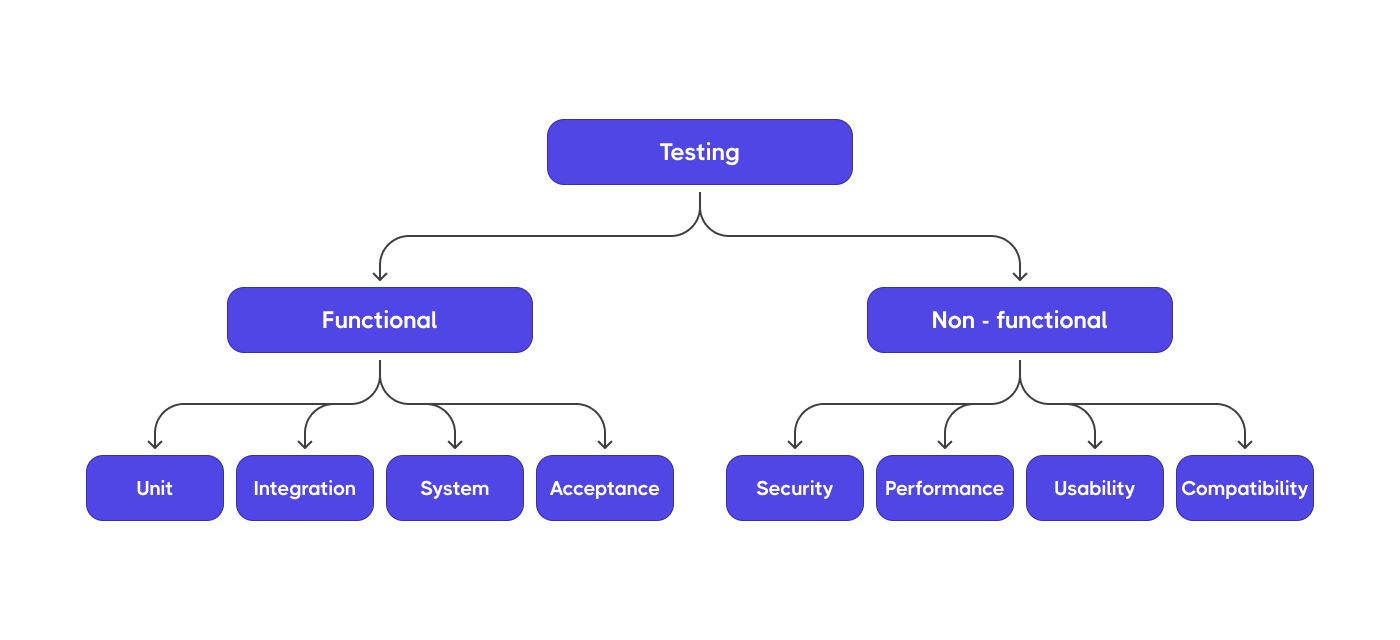
Code testing types are distinguished by several criteria.
Level/Scope
Depending on the object of testing, specialists distinguish unit testing, system testing, integration testing, network testing, and API testing.
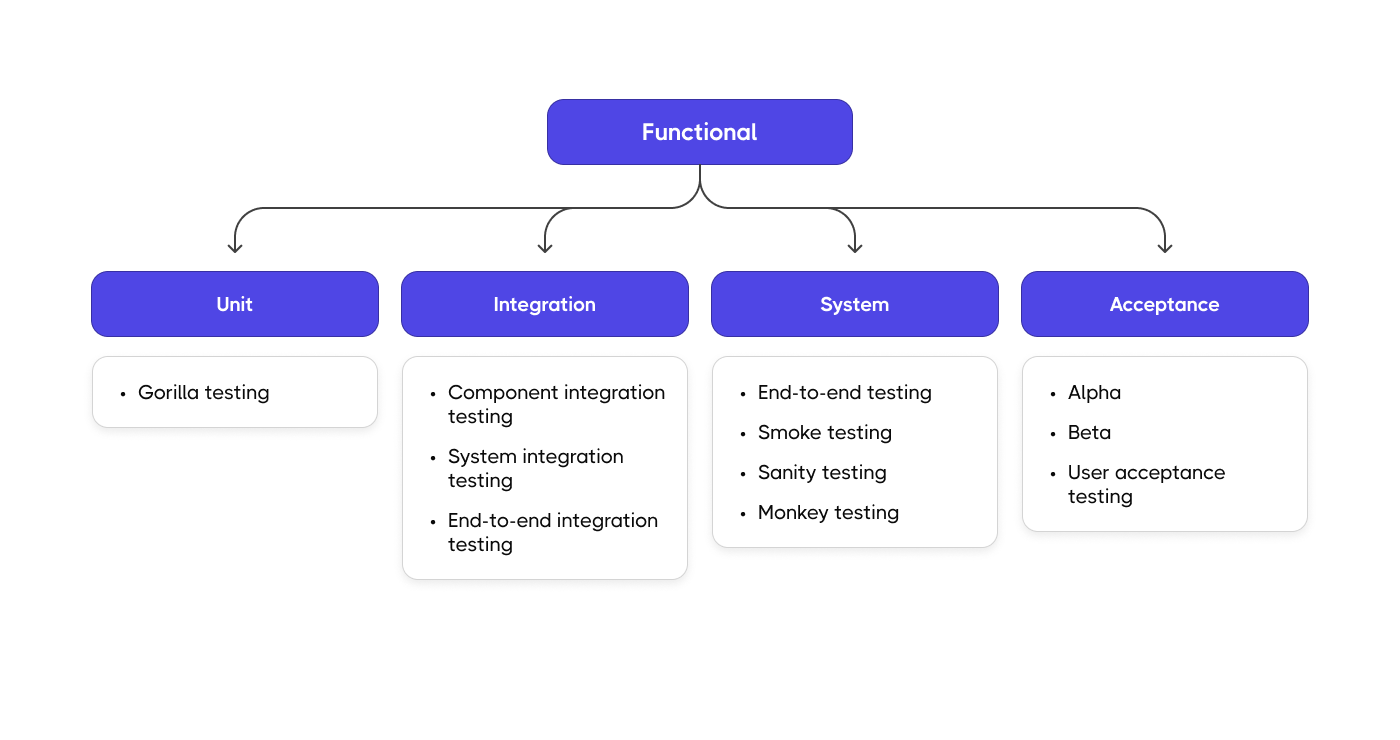
Acceptance testing is one more type in this category that helps testers confirm that the solution meets its business requirements.
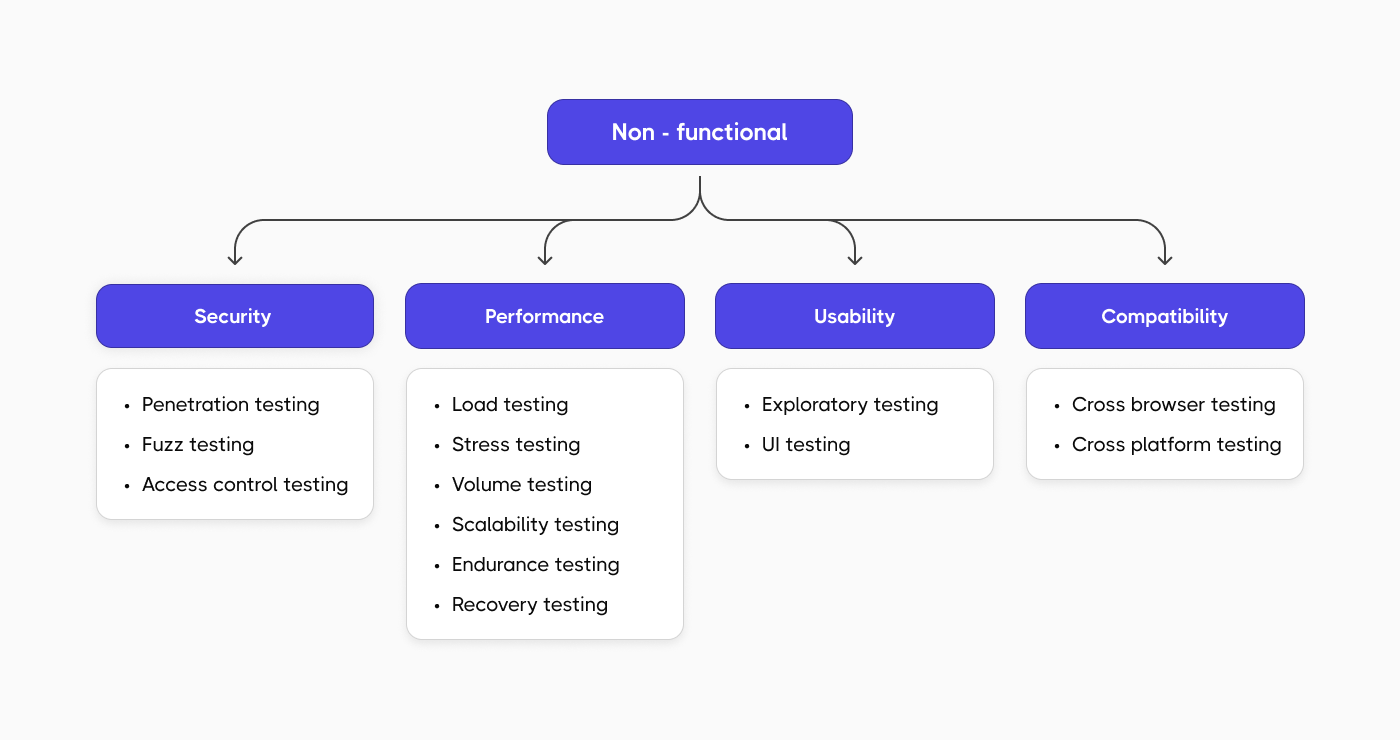
Purpose
According to the goal testing aims to achieve, software checks are divided into functional and non-functional. The former include such procedures as regression testing, smoke testing, sanity testing, UI testing, etc., which assess the software’s ability to operate in accordance with predefined specifications. The latter comprise security testing, performance testing, compatibility testing, usability testing, and the like, ensuring the solution’s quality attributes.
Execution method
You can perform tests either in automated mode with the involvement of dedicated tools or rely on human capabilities by submitting software products for manual testing.
Aspects to check
White-box tests are also called structural or code-based, since they assess internal code logic and are performed when the system is at rest. Black-box (aka behavioral) tests check the external functionality of systems and modules during operation by focusing on inputs and outputs, while ignoring internal code.
Conducting any kind of code testing is impossible without an efficient testing tool. But how can you determine which testing solution to opt for?
Key Features to Look for in a Code Testing Tool
Of course, the major yardstick for choosing a code testing tool is your project’s needs. However, there are universal characteristics a good testing tool should possess.
Ease of Use
To make the learning curve milder, make sure the tool you select has an intuitive user interface and a well-documented pipeline. The QA team should be able to navigate and configure the solution hand over fist.
Automation
Automated code testing tools streamline and facilitate the QA routine immensely by reducing the amount of manual effort to a minimum. Especially valuable are tools for code generation testing and deployment that enable testers to create, execute, and manage test cases with low human intervention.
Integration with CI/CD pipelines
The ability to leverage code testing tools in DevOps practices is essential for making QA an integral part of your development workflow. That is why you should ensure the tools you onboard play well with mainstream CI/CD frameworks, such as GitHub Actions, Jenkins, GitLab, and others.
AI-driven insights
AI code testing tools rely on the power of artificial intelligence, generative AI, and machine learning to boost the testing routine and improve the quality of the final outcome. Their principal software testing use cases are generating test data, identifying patterns, designing and optimizing test cases, and predicting bugs.
Cross-platform support
If your goal is testing web applications, this code testing tool parameter is non-negotiable. However, QA teams tasked with validating other products (such as enterprise systems or mobile apps) will also find cross-platform compatibility handy, enabling them to test various products across multiple platforms and ensure a seamless user experience.
Comprehensive reporting
The reporting functionality helps testers identify issues in no time. Their decision-making and debugging processes are considerably streamlined and facilitated thanks to real-time dashboards, exposed trends, and access to historical data provided by code testing tools equipped with the reporting capability.
Knowing what features to look for in a code testing solution is a necessary starting point, but it doesn’t make the choosing ordeal much easier, since most code testing tools on the market claim to have them. We can simplify your selection process by suggesting top tools that have won universal acclaim.
The Best 3 Code Testing Tools to Choose
1. Testomat.io
Whether you are looking for robust Java code testing tools or need high-end Python code testing tools, Testomat.io has got you covered. This is not a standalone solution but an end-to-end testing platform tailored for validating any type of software written not only in these two most popular programming languages, but also in PHP, Ruby, TypeScript, JavaScript, and .NET.
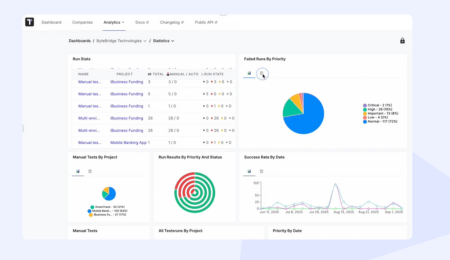
The suite provided by the vendor excels at creating, executing, and managing versatile code testing types (unit, system, API, performance, regression, functional, and more) in manual and automated modes. The reliance on AI mechanisms enables the platform to optimize test generation and orchestration, while user-friendly analytics dashboards ensure complete visibility into vital metrics, such as test coverage, pass/fail trends, execution history, defect tracking, flaky test detection, etc.
Testomat.io integrates well with CI/CD tools (GitHub, Jenkins, CircleCI, and more) and is perfect for utilizing Agile workflows.
You can enjoy all these assets free of charge by harnessing Testomat.io’s vanilla version, or gain advanced capabilities by opting for either of the two commercial plans (Professional or Enterprise).
2. Applitools
The special focus of this tool is UI validation and visual regression testing. Its cross-browser support, visual AI engine, and broad integration opportunities allow the tool to be synchronized with various frameworks (Appium, Selenium, and Cypress, to name a few) and perform batch testing of applications across multiple devices and screen sizes. Plus, you can get detailed and actionable test reports that give you complete transparency of all checks you run.
3. Apache JMeter
If you are looking for a free-source, narrow-target tool honed for load and performance testing of web apps and APIs, JMeter will suit you perfectly. It covers a wide range of protocols (HTTP/S, JDBC, FTP, and more), simulates multiple user scenarios, and supports numerous plugins that significantly extend its functionality scope. JMeter is highly scalable and customizable, and enjoys strong community support.
Key Takeaways
Code testing is a crucial element of the QA process that is called to ensure the solution’s uncompromised quality, accelerate the SDLC, prevent regressions, improve maintainability, reduce product cost, promote collaboration between project stakeholders, and boost user satisfaction.
To efficiently conduct code checks of various types, testers utilize versatile tools. A robust code testing tool should be foolproof in usage, seamlessly integrate with CI/CD pipelines, enable extensive automation, guarantee cross-platform support, possess a comprehensive reporting capability, and leverage AI-fueled mechanisms for test case generation, execution, and management.