




When you validate different functionalities and components of a software application, manual testing can’t satisfy various testing needs and guarantee an uncompromised quality of your software. The exponential growth of software systems to check and testing processes to complete has made it clear that only automation testing can get you covered. This testing involves top-notch software to create and execute numerous test sets in an automated mode. However, the effectiveness of your testing efforts is largely conditioned by their robust management, which can be ensured through leveraging dedicated tools and technologies.
The article explains the difference between test automation and test management, highlights the advantages of test management and test automation integration, showcases best practices for such integration, and dwells on the challenges software quality checks face when test automation is married with test management.
Test Automation vs Test Management
Test automation and test management are two indispensable elements of an end-to-end testing of a software application.
What is test automation? It is the employment of automation tools that are honed to execute predefined test cases across various test scenarios when manual effort required for testing software modules turns out to be too time-consuming and resource-intensive. When you onboard Pytest as a popular testing framework for Python-based solutions or TestNG as a testing framework for Java applications’ unit testing and integration testing, you automate repetitive tasks, improve test accuracy, enhance test coverage, boost test reusability, and speed up the QA routine as one of the key elements within the software development process.
You can make the most of executing automated tests if you harness a comprehensive platform for software testing, enabling experts to run various kinds of checks, including all types of functional testing (regression testing, unit testing, system testing, API testing, and more) and non-functional testing (such as performance testing, security testing, usability testing, etc.).
What is test management? It is a bedrock for testing efforts of any kind. Being a pivotal element of an out-and-out testing strategy, test management presupposes planning, execution, tracking, and reporting of the entire testing process. The ultimate goal of test management is to develop high-quality software that meets all technical and business requirements by formulating test plans, designing test cases, and monitoring test execution results.
In a nutshell, when you automate testing, you ensure fast and efficient test case creation and execution, whereas test management is called to streamline the testing process as a whole through well-thought-out organization and coordination.
Ideally, test automation and test management should be integrated, which brings weighty perks to safeguarding overall software quality.
Benefits of Integrating Test Automation with Test Management
What upsides does the integration of your automation testing framework with test management tools usher in?
Improved test planning and execution
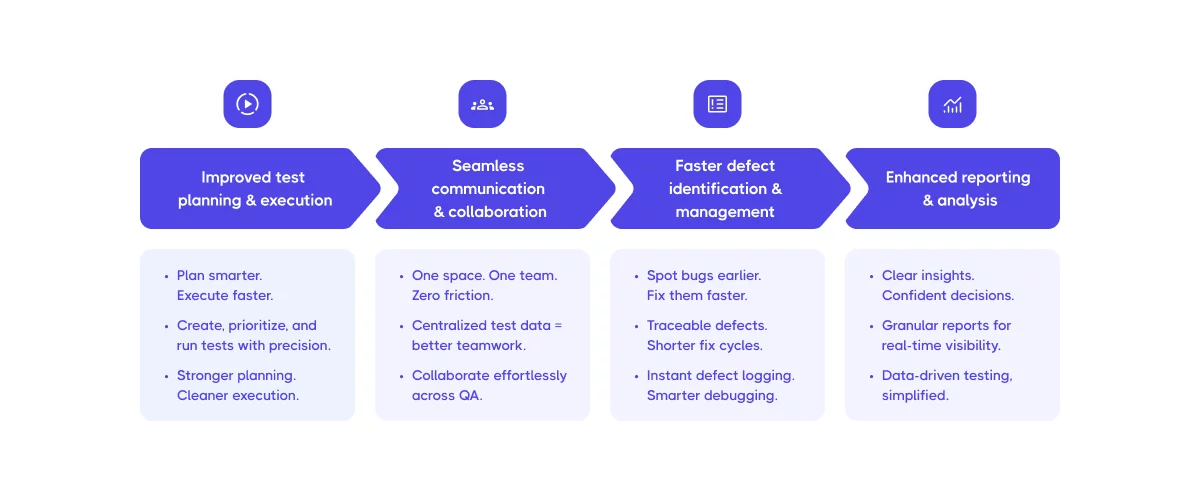
When test management tools are incorporated into the test automation routine, QA teams can devise all-encompassing testing plans that include test cases, test data, and anticipated deliverables. As a result, you can quickly and efficiently create test suites, prioritize them, and schedule test execution, thus ensuring optimal resource utilization, maximum test coverage, and accurate outcomes.
Seamless communication and collaboration
Testers integrate test management tools with automation testing to ensure a joint effort within QA teams. Thanks to test management software, team members get access to a centralized repository containing test cases, plans, and results, share test artifacts and execution outcomes, participate in version control by tracking modifications and history, review automation scripts, work together on test design, and exchange feedback and comments. Thus, combining test management tools with automation testing helps keep all stakeholders on the same page while testing is underway.
Efficient defect identification and management
Detecting bugs and issues in any type of testing is a crucial phase. When you harness a test management tool, all exposed defects are logged and tracked within it automatically. This ability not only enables QA personnel to manage the entire bug life cycle from a single dashboard but also improves root cause analysis and reduces bug-fixing time by providing traceability between defects and test cases.
Enhanced test reporting and analysis
The combination of test management tools and automation testing is essential for generating granular test reports. Such documents contain pass/fail status of tests, their coverage, information on test environments, text execution summary with metrics and KPIs, and other parameters. Having all this data at their fingertips, testers use it as insights into testing progress and results, instrumental for real-time trend identification and decision-making in both software development and testing.
Alongside considerable boons, seamless integration of automated testing with test management tools often has to overcome barriers during implementation.
Challenges of Integrating Test Automation with Test Management
While developing integration scenarios, you should pay attention to the following test automation and test management integration issues.
- Expertise and resources. A successful integration of this kind requires an in-depth understanding of testing tools and their key functionalities, as well as competence in test management. Together with finding qualified engineers proficient in both test automation and test management, you should allocate time and budget for initial setup, regular troubleshooting, and continuous maintenance of the integrated system.
- Tool integration and interoperability. While performing integration, testing tools and test management platforms should be selected based on their interoperability. Besides, data flow synchronization also requires special attention, often necessitating custom integrations and workarounds.
- Maintenance and scalability of automation. Even if you automate test scripts, they won’t stay relevant indefinitely. Updating and upscaling test cases during testing plays a crucial role, as it prevents false positives and negatives, adapts tests to individual software components’ changes, and ensures tests’ flexibility for reuse in dynamic environments.
- Data management and reporting. It is not only about providing the accuracy and consistency of data exchanged between management and automation testing tools. You should also consolidate all test metrics into a customizable, single-view dashboard that presents results of testing individual components and the entire system.
You can address all these challenges properly if you consider the following recommendations.
The Best Practices for Test Automation and Test Management Integration
The successful integration of automated mobile or web application testing with a test management tool is possible if you:
- Perform integration early in the SDLC and do it frequently. Postponing integration until late in the software development cycle leads to accumulating bugs and issues until they escalate and become hard to deal with. Integrating test management tools into automated testing ensures early bug detection, while regular checks prevent complex, unraveling of intertwined riddles.
- Prioritize test cases. Repetitiveness, criticality, and susceptibility to human error are the yardsticks for test case categorization performed by test management tools. Then, focus your test automation efforts on high-risk mission-critical test cases promising the best ROI.
- Choose a proper tool. The test management software you plan to onboard should not only play well with the test automation framework you rely on in your QA routine. It should also align with the tech stack used in product development and with your testing team’s expertise.
- Ensure synchronization and version control. All automated test scripts should be stored in a centralized repository, also known as a version control system (VCS). It allows you to revert to previous versions, track changes, and leverage branching strategies to create new scripts. Then, you should set up links between test cases in the test management tool and the automated VCS scripts they correspond to. Finally, automate integration and synchronization of test status and results between the automation framework and the test management tool.
- Set up a continuous integration environment. By embedding automated tests into your CI/CD pipelines, you provide continuous validation of code changes, ensure early feedback on defects, and receive alerts if a test fails or a performance issue is detected.
Key Takeaways
Automated testing tools are software applications designed for automating QA routines. Their efficiency can be augmented manifold if they are integrated with test management software. The combined system excels at effective test planning and execution, quick defect exposure, enhanced reporting and analysis, and seamless collaboration between stakeholders. The integration points that require attention are team expertise and resources, software interoperability, automation maintenance and scalability, and data management. The keys to successful integration are implementing it as early in the SDLC as possible, test case prioritization, setting up CI/CD pipelines, test synchronization and version control, and selecting a suitable test management tool.
You don’t need to worry about test automation and test management integration if you opt for an all-in-one testing platform that provides both, along with other software testing features.