





There are many myths and different interpretations of how we understand this or that concept, this or that term, or these or those approaches. Test strategy in software testing, especially in the enterprise testing strategy landscape, is one of the most routinely misunderstood. If you search for test strategy online, you can see dozens of the same definitions — often copied from outdated standards written more than a decade ago. Let’s break down what a testing strategy definition really is, so:
What are test strategies?
Practical test strategy conception:
Rapid software testing engineering — a test strategy is the set of ideas that guides our choices about what testing to do.
The focus lies in:
→ set of ideas
→ guide of choices
At the business level:
In the Harvard Business Review (HBR) on strategy — a strategy is an integrative set of choices that positions you on a playing field of your choice in a way that you win.
The key to definition is:
→ an integrative set of choices
This one highly correlates with the enterprise software testing interpretation:
ISTQB glossary — a description of how to perform testing to reach test objectives under given circumstances.
It is about contextual application depending on factors such as risk, industry regulations, safety requirements and available skills, which commonly matter in enterprise testing.
The variety of perspectives among different QA teams:
- A few are interested in test strategy, but lack the know-how.
- Often, automation, regression or performance testing are in silos
- Others confuse it with a test plan, an automation strategy or a company testing policy.
- The third one does not need it, so it does not even exist.
- Some testing teams treat it as a formal document no one reads.
As a result:
Enterprise software test strategy often becomes a buzzword rather than a practical testing tool that helps teams deliver high-quality software.
❌ QA engineers stop seeing real value in test strategies.
❌ Managers reduce strategy to a checkbox activity.
❌ Developing teams jump straight into test plans, automation, regression testing, exploratory testing, API testing or AI tools without understanding why.
— Why enterprise test strategy become so confusing?
The problem is not the lack of information. The real problem isn’t the complexity of the document, the massive test suites, the messy environments, or the conflicting stakeholder interests. At its core, the problem lies in focusing on enterprise strategy as documentation rather than on the decisions and outcomes they provide.
Make no mistake:
✅ Test strategy is about choices, not paperwork!
✅ Testing strategy is more than just defect detection.
✅ Enterprise testing strategy is a proactive procedure.
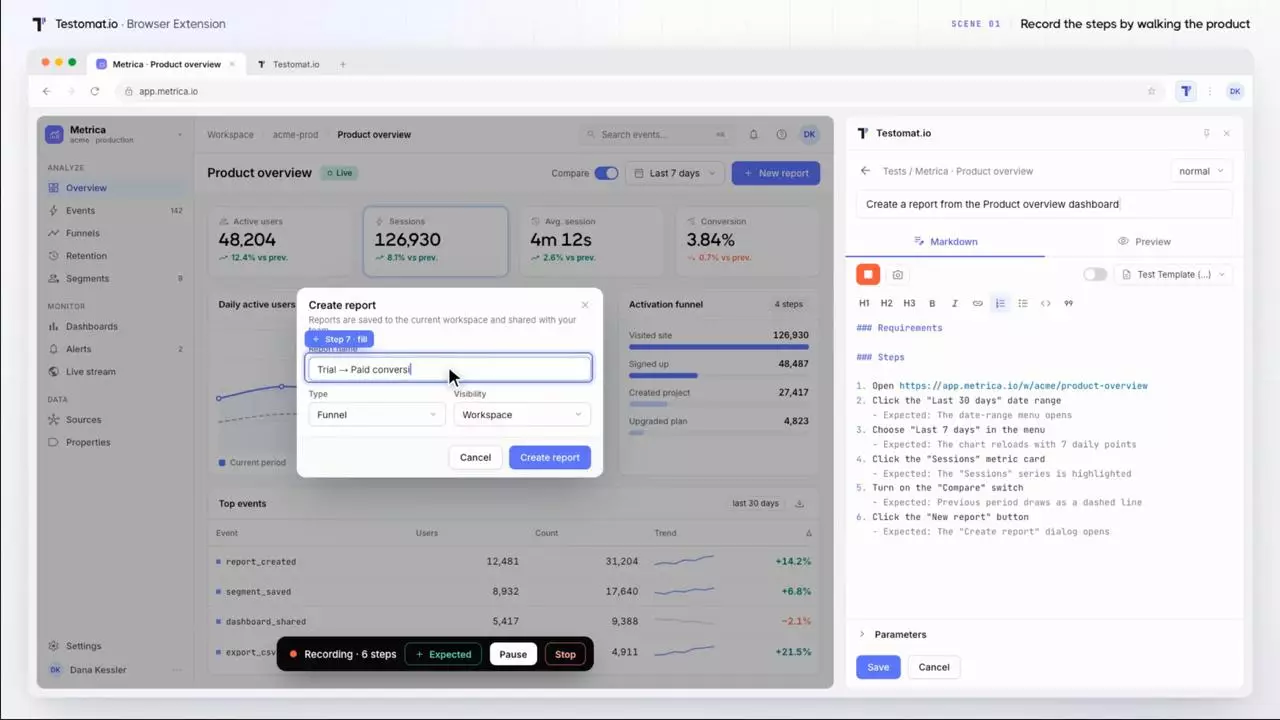
Further down, we know why many enterprise teams struggle with it, and how a modern AI test management platform like testomat.io helps turn testing strategy for large applications into live documentation.
Enterprise software testing strategy components
People often jump straight into developing a strategy. However, for us, it is crucial to understand which approach to choose and why, and only then to determine how we will plan testing efforts at the base.
The foundation of a good enterprise strategy — something even McKinsey uses — is the identification of the core problem. While these businesses are not always infallible gurus, the essence remains:
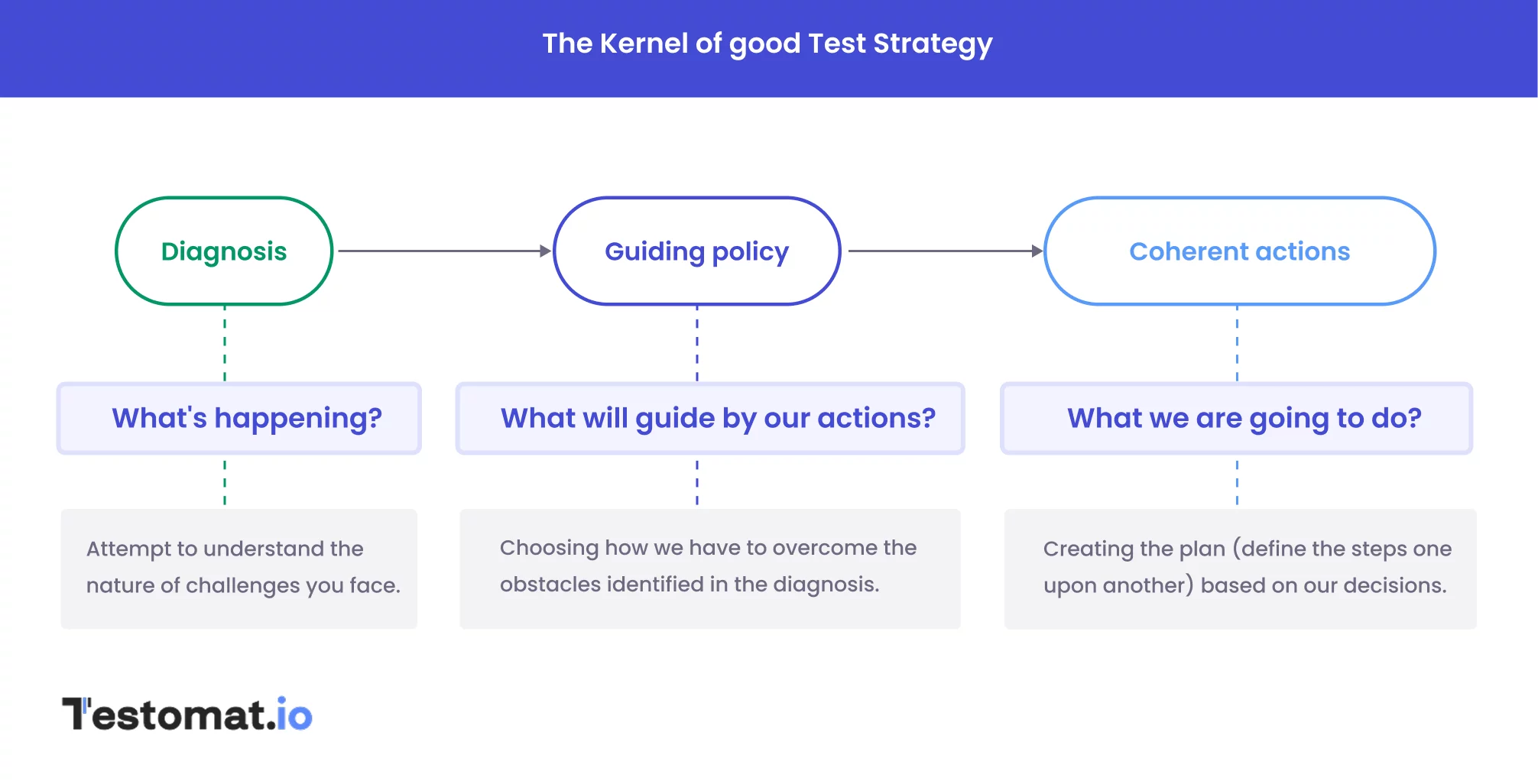
At the start, define which problems we are solving in general. Then, determine how we will achieve the solution. Finally, create an action plan, rather than the other way around. In other words, on this strategic flow: Diagnosis (it is The Problem) → Guiding Policy (it is The Approach) → Coherent Action (it is The Plan). Applied to Quality Assurance, this provides an answer:
Why strategic management scaling enterprise quality with maximum results?
- Diagnosis is an honest look at the obstacles: Fundamentally, strategy is about anticipating risk. A good enterprise testing strategy requires us to imagine: What are the challenges and risks that matter most to our success? Given the system’s inherent complexity, where are the critical points most likely to fail? Often, the fact of an obsolete legacy system is not the worst problem.
- Test objectives & quality goals: This is a clear, shared understanding among the development team of What good enough to release truly means for this specific product? It encompasses the high-level Exit Criteria, Definition of Ready and Definition of Done for testing hand-offs.
- Definition of scope: This component identifies the parts of the system that will be tested and excluded, where testing must focus first, while accounting for our real-world limits regarding time, budget, and environment availability — and why.
Basically, an test strategy in software testing is a high-level document that connects a company’s big-picture vision to the daily actions of the Quality engineering team. Test strategy defines the overall approach, principles and logic flow required to provide stakeholders with the critical information they need to make informed decisions.
In addition, it is worth highlighting the insights of Wayne Roseberry
Moving beyond the testing phase — a solid testing strategy does more than just dictate a testing schedule or a timeline and all conditions are created; it guides the entire development lifecycle, not only testing phase.
When developing an enterprise test strategy, you must account for the immense scale and the strict regulatory environments inherent in large organisations. Due to the high cost of errors and the potentially irreversible nature of some changes, testing processes will naturally be slower than in start-ups. Within this specific context, complementary artifacts — such as the Test Plan, Requirements Traceability Matrix (RTM), and Documentation Analysis serve as the foundational tools to ensure complete coverage and transparency of the enterprise testing process.
Strategy VS Plan: The “Chicken and the Egg” of Testing
This is a common dilemma in software testing and quality assurance: which should come first — the Test Strategy or the Test Plan? The second common mistake in QA is confusing strategy with planning, even among seasoned professionals. What exactly can we extract from this widely recognized comparison table:
| Aspect | Test Strategy | Test plan |
| Definition | The test strategy is a high-level document that captures the approach we use to test the product and achieve the goals. | Test plan document is a document which contains the steps for all the testing activities to be done to deliver a quality product. |
| Level of detail | General guidelines and principles. | Detailed information about resources, timelines and responsibilities. |
| Key components | Typically, enterprise software testing strategy components are: Scope and Overview, Test Approach, Testing tools, Industry standards to follow, Test deliverables, Testing metrics, Requirement Traceability Matrix, Risk and mitigation, etc., Reporting tool and Test summary. | Components of the test plan include Test Plan Identifier, Features To Be Tested, Features Not To Be Tested, Approach, Pass/Fail Criteria, Suspension Criteria, Test Deliverables, Responsibilities, Staffing and Training Needs, Risks and Contingencies, etc. |
| Audience | The project manager is involved in its creation. | Intended for the testing team. It is prepared by the QA test lead or the test manager. |
| Derived From | It is derived from the Business Requirement Specifications (BRS). | It is derived from the Product Description, Software Requirement Specification (SRS). . |
| Flexibility | More stable and less frequently updated. | More dynamic and may change frequently based on project needs. |
| Organizational Scope | It is defined at the organisation level and can be used for other projects of a similar nature. | It is defined at the project level. |
What is this test plan actually about?
A plan is simply the roadmap for executing our vision in an enterprise-scaled testing methodology. Our vision, however, is defined by our strategy. Strategy is the foundation, even if it feels quite abstract within our project context. We must first understand the specific problem we are trying to solve and the methods we will use to solve it. Only then can we create a plan to test our application — a list of agreements between the team and the client — to execute our enterprise strategy.
The plan implements the strategy!
A detailed Test Plan needs that strategic direction to avoid being a chaotic wheel every sprint/release — yet creating a meaningful plan requires understanding the product’s risks, scope, and quality goals (which the strategy helps define).
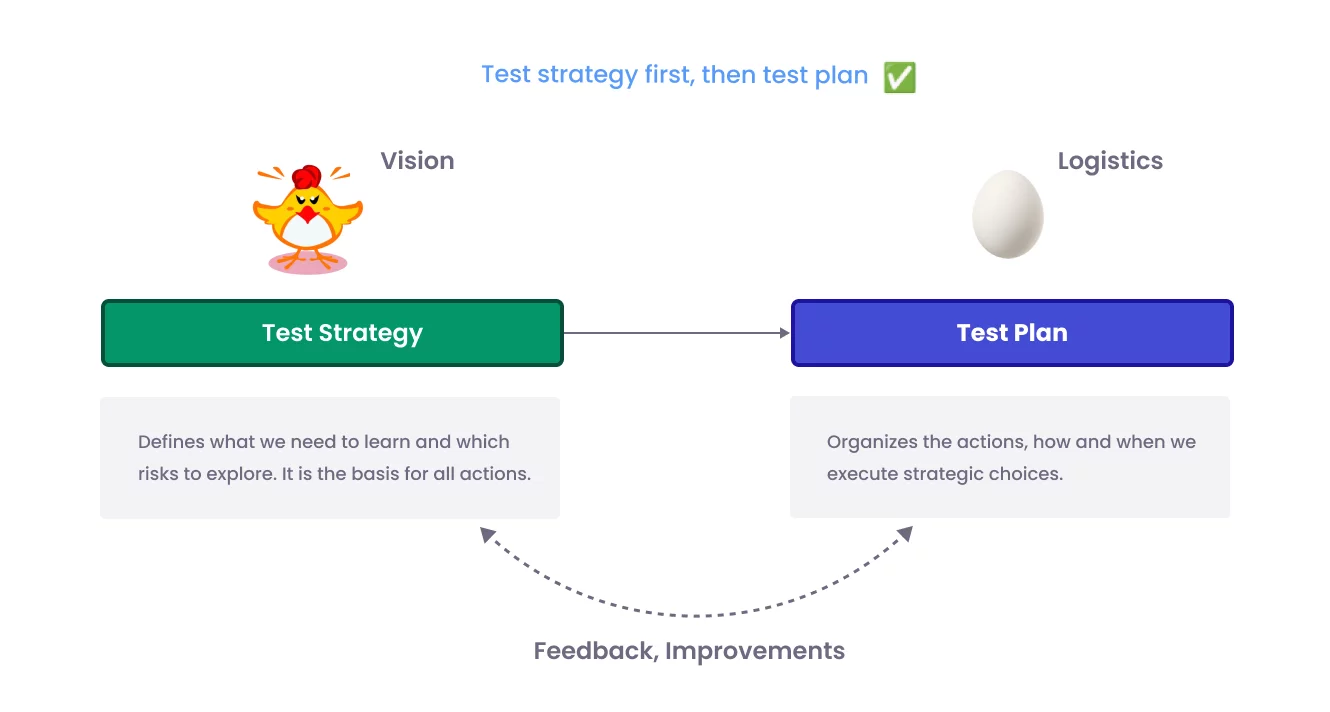
So, the correct order is to go down from the test plan to the test strategy:
- Identify the problem and risks.
- Choose a testing approach (strategy).
- Create a test plan to execute that strategy.
Many think this is a “chicken and the egg” situation, but it is not. A good plan is born from a clear understanding of why a specific strategy was chosen. That is the only way to move forward and effectively solve the testing problems. At the same time, without a plan, we cannot validate whether our enterprise testing strategy actually works in reality.
The reason the enterprise test strategy fails
While a strategy can break for many reasons depending on the unique context of a project, we will focus on a few of the author’s firsthand experiences.
#1: When Agile testing lacks objectives — it’s illusion of progress
In Agile contexts, Scrum/Kanban, especially AI testing now, this illusion often lies between 2 extremes:
Common use-case 1:
| We are 💪 Agile! Let’s build something, show it in two weeks, and keep moving ahead. We do not need heavy documentation — we test continuously! So, development teams skip best practices for a good enterprise testing strategy and keep a very lightweight strategy, just a one-page mention. | When testing lacks a strategic foundation, it results in chronic inconsistency across sprints, releases, and teams. One sprint might focus heavily on UI automation, while the next shifts to manual exploratory testing with no coherent focus on risks. Instead of a predictable, scalable process, every sprint reinvents the testing process, creating a pure illusion of progress. |
This leads to duplicated efforts, overlooked non-functional requirements — such as performance, security, and accessibility — and a steady accumulation of defects in production.
Other common use-case 2:
| Testing teams create full ISTQB-style test plans for each sprint and release, with hundreds of test cases generated by AI, exact schedules, and entry/exit criteria. | Rigid plans become outdated by mid-sprint due to shifting requirements, leaving testers to either ignore the plan entirely or waste valuable time constantly updating it. |
This is an illusion that a comprehensive testing plan exists, but it no longer reflects the project’s reality.
#2: Ineffective collaboration
When developers, testers, and business analysts work in separate silos, the entire testing process slows down and critical gaps appear at the boundaries between teams. Enterprise testing involves multiple stakeholders, including developers, testers, and business analysts, who should work together effectively to achieve thorough and accurate testing. When communication is poor, the process slows, expectations get misaligned, feedback gets delayed, and multiple team members test the same area without coordinating their efforts.
To deal with communication issues, you should do the following:
- Promote transparency where everyone accesses the testing process and results
- Foster open communication, providing regular opportunities for feedback and discussion
- Encourage teamwork and collaboration where each team member expresses their ideas and works together to achieve a common goal.
In practice, in enterprise projects, it is usual to assign a named QA owner for each major feature area or module. That person reviews test cases before sign-off, confirms coverage against requirements, and makes the release recommendation. Accountability has to live with a specific person, not the team in general.
#3: Testing in isolation or How to eat an elephant?
From a strategic thinking perspective, when something is huge, essentially, it is tempting to simplify everything. Decomposing is breaking down a problem into smaller parts, similarly to prioritization it is a widespread method in enterprise test strategy. Then you can approach testing scope in stages, solve them step by step, and generally see more factors. It sounds simple, but you need to avoid:
Decomposition trap it is when you cut the “big elephant” into parts, and forgot how these parts interact. So, do not remember the system as a whole.
In truth, isolation is very dangerous in software testing, as it creates the illusion of control. Isolation proves that a function exists without ever proving that the product actually works. It is worth noting that the enterprise test strategy highlights the problem of isolation. Consider how you evaluate your own testing methodology. If your tests only validate a single hypothesis — such as, Does this API request work? — you are losing the bigger picture. The API might return a successful 200 OK status, but what if the end-to-end feature does not work?
It is important to remember that testing is about finding information about the level of quality, not just testing hypotheses. We must constantly evaluate whether our testing approach actually works — not just after a major incident, but also during releases. The use of automation and AI in isolation often fails at this point as well. More on this next 👀
#4: Green dashboard trap of automated test reports
We will discuss one of the most dangerous and widespread pitfalls in modern software quality practices — an illusion that an automated test suite consistently passes. It is particularly common in dominant CI/CD environments (everything shows green on dashboards, reports, and build status), leading teams to believe the software is stable, low-risk, and ready to release, while serious defects still escape to production, users complain, or outages occur.
Yeah, the main problem is isolating automation from the overall vision. You have hundreds of atomic tests and green reports to tell the client that everything is fine, but this is wrong. Automated tests only check what they’ve been explicitly told to check. Functionality may work fine, yet the product fails to meet the actual requirements of the end users.
Another critical factor for successful test automation is testability, as part of the test design. For example, some features of your product may be designed in a way that makes them difficult to automate. Ultimately, testing return on investment only when the product’s architecture is intentionally structured for ease of testability. By prioritizing this, the team expands the possibilities for automation — delivering real business value rather than just Closed Tickets. The automation test strategy within the enterprise testing policy must be discussed with the development team from the beginning to anticipate architectural roadblocks and suggest alternative approaches before they become technical debt. Like choosing the specific automation before knowing the challenge. Managing test flakiness is here too; we won’t be diving into it today. Deep-dive articles on the subject: Overcome Flaky Tests: Straggle Flakiness in Your Test Framework
If your team is trapped in a ‘green world’ while bugs continue to escape into production, your priority must be to audit the test suite and refactor it against actual risks. It often points to an overloaded suite of low-value, outdated automation that provides a false sense of security, increasing the pressure to build and release faster. In case you are Manual QA, do not be afraid to ask questions about: What specific task does the particular autotest solve?
Additional enterprise testing strategy mistakes
Testing is not about us just taking something and testing it. The strategy is that when we try to focus on scaled testing, we, of course, try to look for the fastest solution, because we are absolutely pressed by the deadlines that the client, management, in general, the market sets for us, and the number of sprints during which release magic should happen, right? Look for other mistakes we can make along the way,
This signal in testing should be highlighted as extremely dangerous:
- Teams show test sets that display productivity, but they do not correlate strongly with actual software reliability or user satisfaction.
- Optimising only for what is easy to test.
- High automation percentage or code coverage numbers (e.g., We have 85% coverage!) while critical business scenarios, edge cases, or non-functional risks remain untested.
- Running thousands of automated regression tests that pass reliably — but production bugs still escape because the suite focuses on happy paths and ignores exploratory testing or real-world variability.
- Relying on velocity/sprint burndown as a proxy for quality, ignoring escaped defects or user feedback.
- Using plans as short-lived tactical tools (not artifacts for audit).
AI & automation in enterprise test strategy implementation
Traditional test strategies focused on manual and scripted test automation approaches with fixed pyramids; today’s modern enterprise test strategies treat AI-augmented automation as a foundational layer in the testing pyramid.
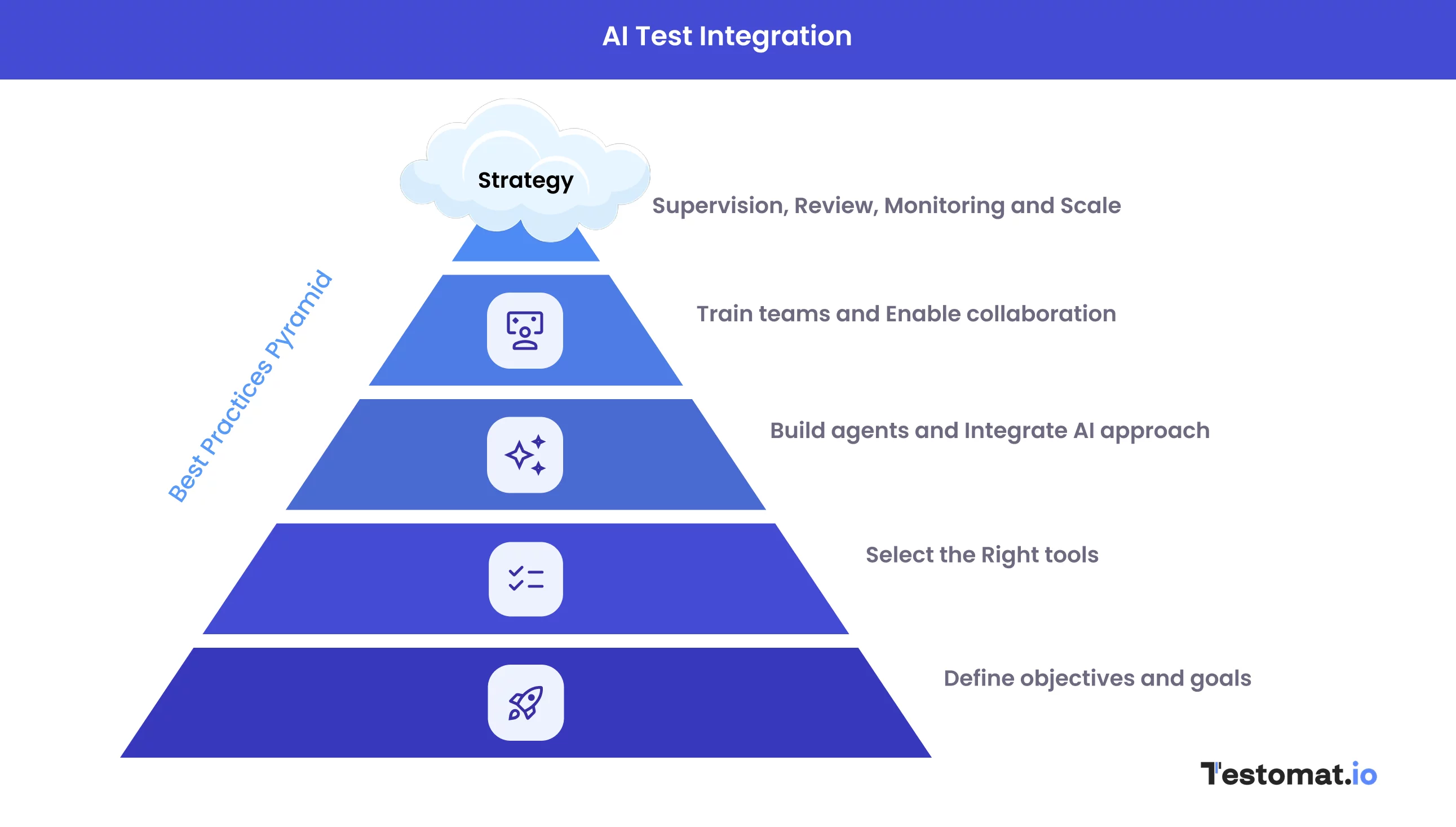
The new evolution distinguishes strict roles now in the balance of human and AI collaboration. QA engineers become quality intelligence specialists who oversee AI outputs.
AI orchestration for scaling your testing
The key is applying AI with context and control, not blindly. You can easily use AI as your architectural partner to link Strategy (Vision) and Plan (Logistics) adjust based on real-time feedback. Implementation of AI in test strategy handles reduce time consuming in repetitive tasks; humans focus on strategy, exploratory, ethics, complex risks.
Integrating AI into your test strategy automates time-consuming, repetitive tasks, allowing human testers to shift their focus toward high-value activities, for instance, tracking strategy, exploratory testing, ethics, and complex risk assessment.
GenAI generates test cases and test scripts from natural language requirements, user stories, or even screenshots. It creates synthetic non-linear test data that mimics real-world noise, suggests fixes for broken locators (self-healing), and optimizes suites by removing redundancy. Test strategies now include targets for handling of regression + exploratory discovery.
Use AI to pilot the system’s units, their seams or pain points, which are the most common places for failures and recognize patterns to find a gap. It answers us: What did we miss? And often helps find a solution to our problem.
Feed your requirements into an AI to check for Testability. Ask: Is this requirement verifiable? What data is missing to make this testable?
With widespread use of AI assistants (Copilot, etc.), strategies now mandate validation of hallucinations, security flaws, code, edge cases and other artifacts produced by AI.
Why test strategy matter?
→ Test strategy turns “Let’s test something” into a focused search for decision-making information.
→ Test strategy helps guide the development schedule.
→ A good strategy protects from testing in isolation and the illusion of control.
→ Automation is a part of the test strategy, not a replacement for it.
→ Testability is a design responsibility, not just a testing problem.
→ Any practical test strategy must take into account time and constraints.
A testing strategy is a way of structuring critical information that empowers stakeholders to make informed, data-driven decisions. To gather the necessary insights, a good enterprise test strategy answers the following questions, highlighting that they are critical questions:
— What is the current level of quality, and are we ready to proceed (Go/no Go)?
— Is the product, in its current state, ready for release into production?
— Do we need time and the right conditions?
Facts give stakeholders a deeper understanding of whether to release or invest further; Stakeholders can be at different levels and have different needs. They might be team members (Project Owner, Project Manager), the end customer or our clients.
For QA manager | How to sell strategy to customer and team?
The most common question: How can you justify spending 16 hours writing a complex enterprise testing strategy when you could be writing a bunch of autotests in that time?
Testing is not just a process; it provides the client with information on the basis of which he decides: Will the product make money, or can it even be released to the market? Perhaps building a strategy will show that half of your activities are unnecessary.
The document definition scares everyone: developers, managers, and even QA itself. People want to write code and tests, not executive summaries in English. Literally, within a risk management test strategy is an insurance, which guarantees that your testing will not crumble in a week and is worth its cost. A robust enterprise testing strategy is a preemptive strike against risks. It collects what could stop our releases.
A trick from Yevgeny:
Don’t tell the team that you are writing your enterprise strategy right now 😏
💡 Start by discussing the problem.
💡 Collect the risks that the team will voice.
💡 Discuss how to mitigate these risks.
— This is the basis of your strategy!
Then you simply record these agreements as an action plan. And sell the customer not a piece of paper, but a case study of a specific dangerous area that will save money for the business.
After-Action Review: When to review strategy?
❌ Strategy cannot be static. If you do not ask yourself the question: Is my enterprise strategy working? Must disappoint you, meaning you are simply using a mediocre template that does not bring any benefits. It is necessary to monitor whether the strategy has any deviations or degradations. Even when the testing process seems smooth, it is vital to conduct a retrospective and think about what can be improved. What went well, and where did we miss?
These guiding review questions help you audit the strategy and refine the approach:
— When did we actually realize whether our test strategy worked – before release, during an incident, or only after?
— What signals did we miss that should have told us to change the strategy earlier?
— Did our strategy focus on the most important risks, or only on what was easiest to test?
— What did our tests in isolation fail to tell us about the behaviour of the whole system?
— Did we collect enough information about product quality to support a clear Go / No Go decision?
— Where did testability (design, architecture, data) help us and where did it block us?
— Who in the team felt responsible for challenging the current strategy or saying that our decomposition was leading us in the wrong direction?
Feel free to implement these Quality Gates at every stage, level, and testing approach; it creates a structured flow of data. At each gate, you analyze the gathered information to determine how it contributes to your overall understanding of the product’s quality.
Golden rule: Ideally, time for After-Action Review (analysis after actions) and work on risks should be built into your contract.
The best teams avoid paralysis by starting small: draft a minimal viable strategy → apply it to the next release’s plan → retrospect and iterate. Treat it as an ongoing process: Review/Refresh strategy quarterly as the strategy matures.
What’s up?
We’ve learned that strategy is primarily about clear communication and a deep understanding of the application architecture. The lack of well-tuned processes and a mature enterprise testing framework leads companies to incur millions in preventable losses. Strategy is always about risk and how to deal with it proactively. Automation, CI/CD, and AI are critical, but they are only effective when connected to real workflows. On the other hand, focusing on business is often more important than focusing on the testing routine. The enterprise test strategy only becomes truly valuable after you have run a handful of real Test Plans and learned what actually works. So, it should not be a siloed phase at the end; it must be woven throughout the software development life cycle (SDLC) from start to finish