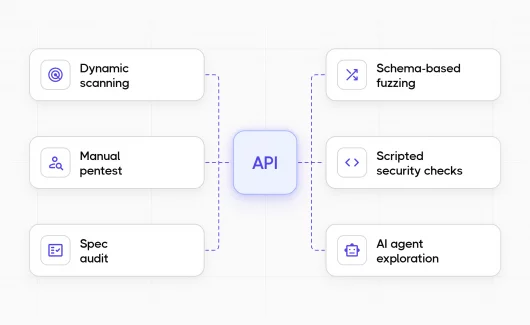


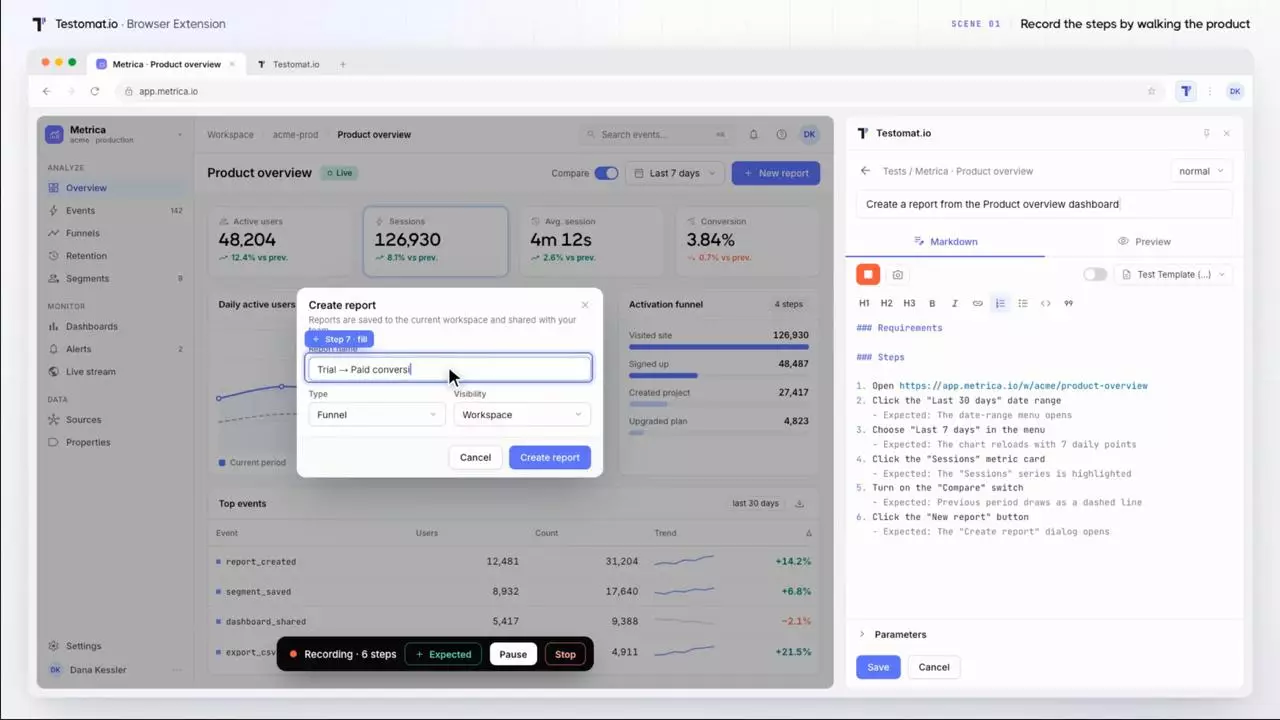




Every modern app depends on APIs – and every release depends on how well you test them. As software architecture evolves toward microservices and cloud-native applications, APIs have become the invisible threads connecting everything from mobile apps to enterprise systems.
API automation testing is the practice of using automated scripts and tools to validate API functionality, performance, and reliability without manual intervention. It ensures that these critical connections work flawlessly across every deployment.
Choosing the right API automation testing tools determines whether your team catches bugs early or discovers them in production. The difference between a smooth release and a chaotic rollback often comes down to how effectively you can automate, manage, and track your API tests across complex workflows.
Why API Testing Matters in Modern QA
APIs serve as the backbone of microservices architecture and system integrations. They enable different software components to communicate, share data, and coordinate actions.
When an API fails, it can cascade through multiple services, affecting user experience across your entire application ecosystem.
Modern development teams face several API testing challenges that make automation essential:
- Unstable Test Environments: APIs often interact with third-party services, databases, and authentication systems. These dependencies create unpredictable test conditions where manual validation becomes unreliable and time-consuming.
- Complex Dependencies: A single user action might trigger calls to five different APIs, each with its own response format, error handling, and performance requirements. Manually testing these chains for every release is impractical.
- Data Validation Complexity: APIs handle structured data in formats like JSON and XML. Validating schema compliance, data types, and business logic rules requires systematic checks that humans can easily overlook.
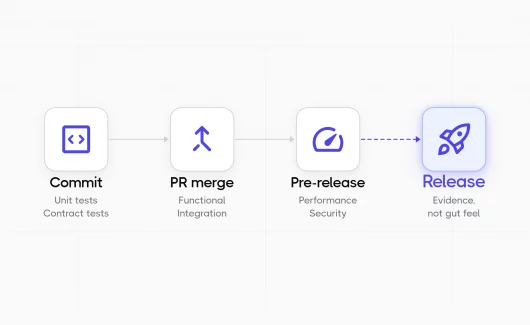
The benefits of API test automation address these challenges directly. Early bug detection happens because API tests run faster than UI tests and can execute continuously in your CI/CD pipeline. A broken endpoint gets caught in minutes, not days.
Faster regression testing means your team can validate hundreds of API scenarios in the time it takes to manually test a handful through the UI.
Better coverage than UI-only testing comes from the ability to test edge cases, error conditions, and data variations that are difficult or impossible to trigger through a graphical interface.
API automation transforms testing from a bottleneck into an enabler of rapid, confident deployments.
What Is an API Automation Testing Tool?
An API automation testing tool is software that programmatically sends requests to APIs and validates their responses against expected outcomes. Core functions include request simulation across different HTTP methods, response validation for status codes and data accuracy, data-driven tests that run the same scenarios with multiple input sets, and system integration with development workflows and testing frameworks.
It’s important to distinguish between two categories in this space. API testing tools like Postman, REST Assured, and SoapUI focus on creating and executing API tests. They provide interfaces for building requests, writing assertions, and running test collections. API test management platforms like Testomat.io focus on organizing, tracking, and reporting on those tests across teams and projects. They integrate with testing tools but add layers of collaboration, visibility, and analytics.
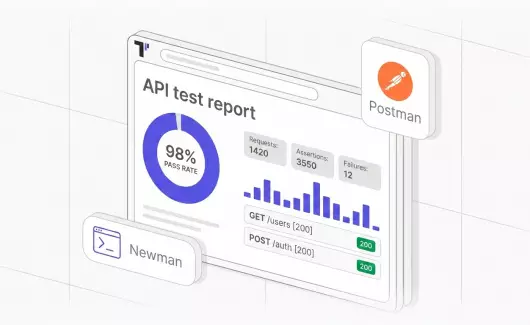
Why automation is key becomes clear when you consider the alternative. Manual Postman checks work fine for exploratory testing or debugging a single endpoint. But when you need to validate 50 APIs across three environments before each deployment, manual clicking becomes unsustainable. Automation moves you from reactive spot-checking to continuous, script-based validation that runs automatically whenever code changes. Tests execute in parallel, catch regressions immediately, and provide consistent results that humans can review rather than perform.
The shift from manual to automated API testing isn’t just about speed – it’s about reliability and scalability as your application grows.
Key Features to Look For in an API Testing Tool
When evaluating API automation testing tools, several features separate robust solutions from basic utilities.
- Multi-protocol support ensures your tool handles REST, GraphQL, SOAP, and emerging protocols like gRPC. Modern applications rarely use just one API style, so your testing tool needs flexibility across different communication patterns.
- Assertions and schema validation capabilities let you verify not just that an API responds, but that it responds correctly. Good tools provide built-in assertions for status codes, response times, header values, and JSON/XML structure. Schema validation confirms that response data matches expected formats, catching breaking changes before they reach production.
- Reusable test suites and parameterization prevent duplication and maintenance headaches. You should be able to define test templates once and run them with different data sets, environments, or configurations. Parameterization transforms a single test into dozens of scenarios without writing repetitive code.
- CI/CD and version control integration connects your API tests to modern development workflows. Tests should trigger automatically on commits, run in containerized environments, and report results directly to your pipeline. Version control integration means your test code evolves alongside application code with full history and branching.
- Reporting and test history provide the visibility teams need to improve quality over time. Real-time dashboards show which tests are passing, failing, or flaking. Historical data reveals trends like increasing failure rates or performance degradation that indicate deeper problems.
- Collaboration and test documentation features ensure knowledge doesn’t stay siloed with individual testers. When tests are discoverable, documented, and linked to requirements or user stories, the entire team understands what’s covered and what gaps exist.
If you’re managing multiple API test suites across teams, visibility and traceability become must-haves. Without centralized management, you end up with scattered test scripts, unclear ownership, and no single source of truth for API coverage.
How Testomat.io Simplifies API Test Automation
Testomat.io takes a unified approach to API test automation by integrating seamlessly with popular testing frameworks while providing enterprise-grade test management capabilities that standalone tools lack.
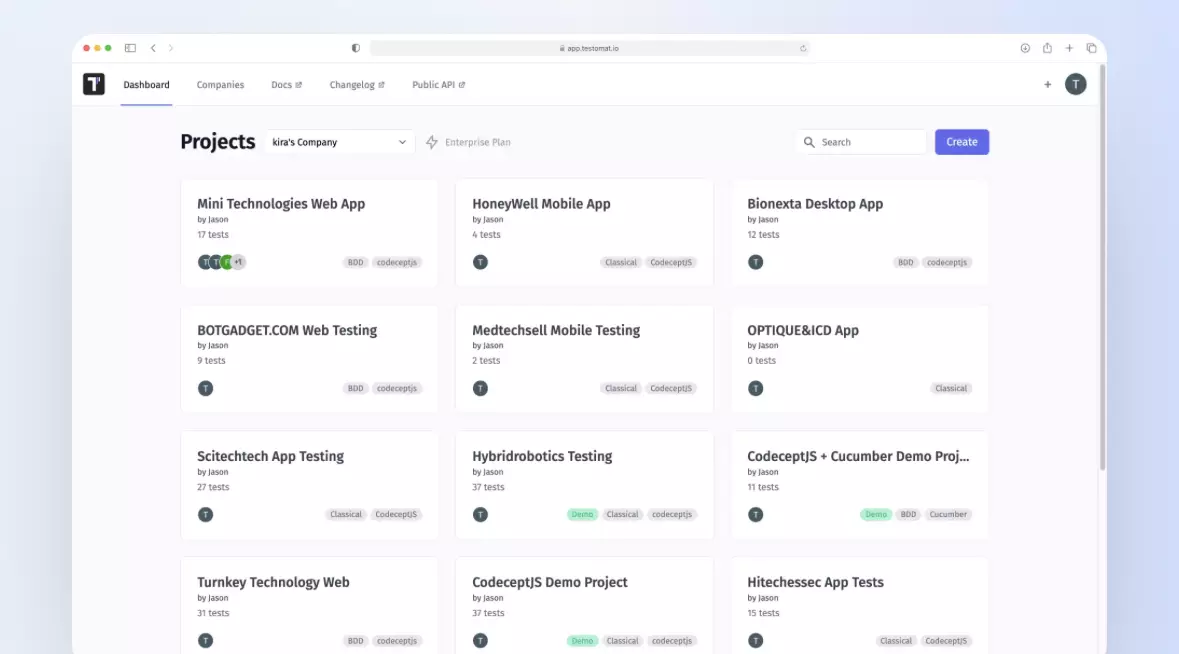
- Unified Test Management: Instead of juggling separate tools for API tests, UI tests, and manual tests, Testomat.io provides one platform for all testing activities. This unified approach means your team sees complete coverage across test types, understands dependencies between UI and API layers, and tracks quality metrics in a single dashboard.
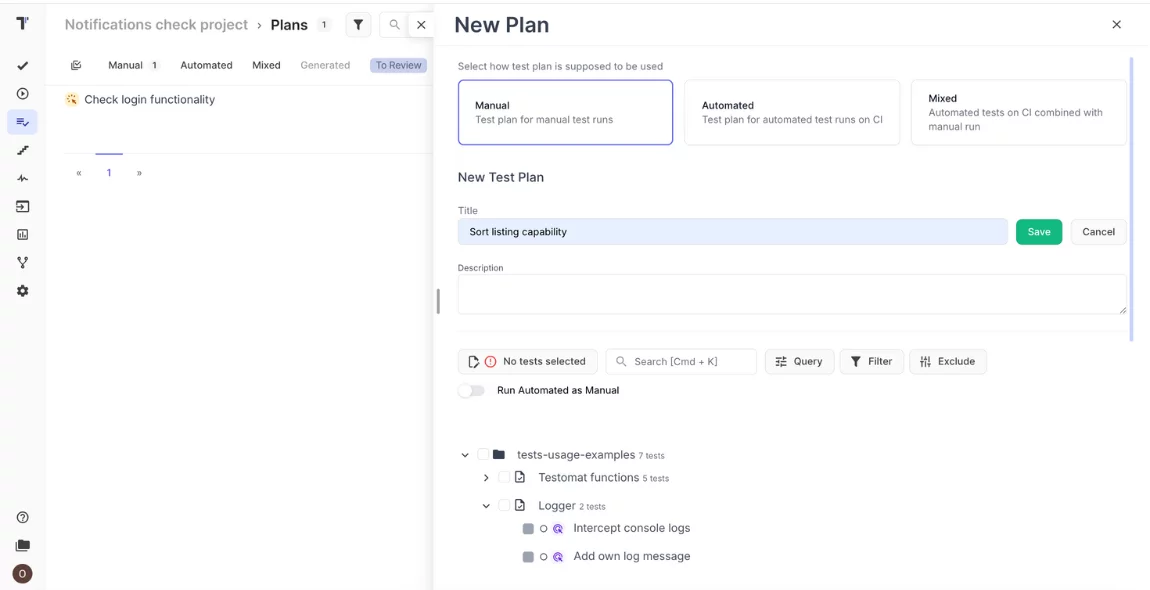
- Live Dashboards and Real-Time Reporting: When API tests run in your CI/CD pipeline, results stream directly to Testomat.io dashboards. Teams see live execution status, failure rates by environment, and detailed logs with request/response data for debugging. Public read-only reports let stakeholders monitor testing progress without accessing the full platform.
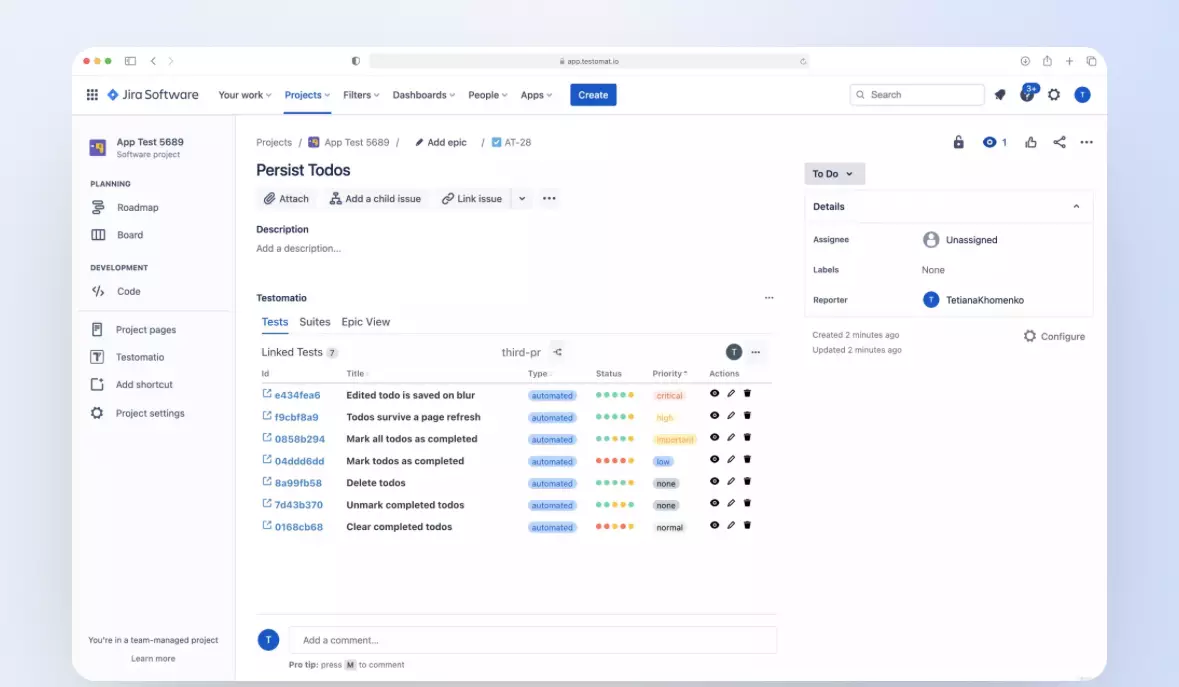
- Jira and GitHub Synchronization: End-to-end Jira integration provides fully bidirectional sync. Create tests from Jira tickets, link test runs to issues, and see execution results in Jira dashboards without leaving your workflow. GitHub integration means test updates appear as pull request comments and failure notifications route directly to relevant repositories.
- CI/CD Pipeline Compatibility: Testomat.io provides native reporters for Jenkins, GitHub Actions, GitLab CI, Azure DevOps, and other popular platforms. Built-in reporter pipes require no customization for most frameworks. Tests execute in parallel, failed tests can rerun automatically, and results integrate with your existing pipeline dashboards.
- Real-Time Team Collaboration: Comments on test cases enable discussions about flaky APIs or validation approaches. Assignments distribute API testing work across team members with email notifications. Version history tracks who changed what tests and when, supporting retrospective analysis when issues emerge.
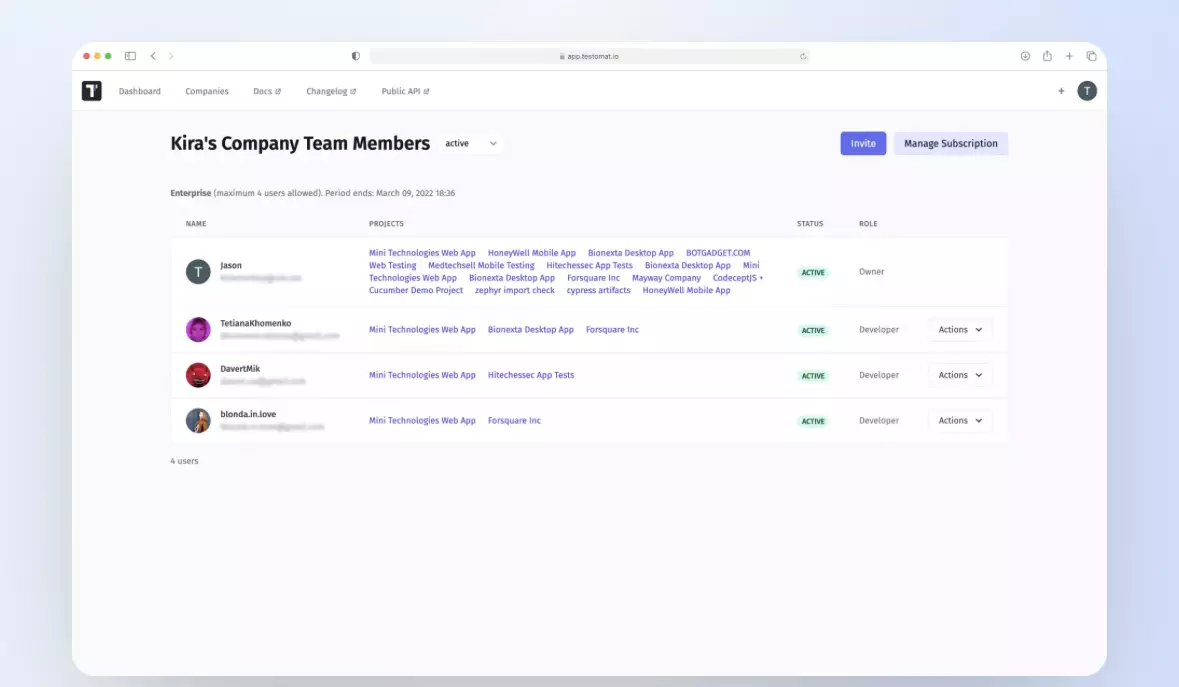
A manual API testing workflow typically involves a tester running Postman collections locally, copying results into spreadsheets, manually updating Jira tickets, and hoping developers see the failure reports. With Testomat.io, the same workflow becomes fully automated: tests run on every commit, results appear instantly in centralized dashboards, related Jira tickets update automatically, and the entire team sees exactly which APIs are stable and which need attention.
Comparing Testomat.io with Other API Testing Tools
Understanding how Testomat.io fits in the API testing landscape helps teams make informed decisions about their tooling strategy.
| Feature / Tool | Testomat.io | Postman | REST Assured | K6 |
| Scope | API + UI test management in one platform | API testing only | API testing via Java library | Performance testing primarily |
| CI/CD Integration | Native integration with major CI/CD platforms, visual dashboards, no extra setup required | Via Newman & monitoring services; requires configuration | Standard build tools (Maven/Gradle); no built-in reporting | Good performance test CI/CD integration; limited functional test support |
| Centralized Reporting | Real-time dashboards, flaky test analytics, automation coverage, historical comparisons | Limited; mostly via paid monitoring | Minimal; relies on standard test framework outputs | Performance-focused; lacks broad test management visibility |
| Collaboration Features | Comments, assignments, role-based access, shared dashboards | Basic team workspaces, shared collections | None beyond version control | Basic team support, not designed for collaboration |
| Jira / GitHub Integration | Deep bidirectional integration, auto-sync test status, link requirements, update issues | Limited via webhooks & API calls | Requires custom integration code | Requires custom integration code |
| Key Differentiator | Orchestrates tests across tools & team members; enterprise-grade test management | Best for API development & ad-hoc testing | Programmatic API testing | Specialized in performance testing |
The key differentiator is that Testomat.io operates at a different level than pure testing tools. While Postman excels at API development and ad-hoc testing, and REST Assured provides powerful programmatic test capabilities, Testomat.io orchestrates testing activities across tools, frameworks, and team members. It’s the management layer that makes enterprise-scale API testing sustainable.
Best Practices for Scalable API Automation
Building an effective API automation strategy requires more than just tools – it demands disciplined practices that scale as your application grows.
- Start with Clear API Specifications: Document your APIs using OpenAPI (Swagger) or GraphQL schemas before writing tests. Specifications serve as contracts between API producers and consumers. With clear specs, tests validate against documented behavior rather than implementation details, making tests more maintainable as code evolves. Import these specifications into your testing tools to auto-generate baseline test scaffolding.
- Combine Contract, Integration, and Performance Tests: Don’t limit API testing to functional validation. Contract tests verify that APIs honor their published interfaces, catching breaking changes early. Integration tests ensure APIs work correctly when combined with other services and systems. Performance tests identify latency issues, throughput limits, and scalability problems. A comprehensive API testing strategy addresses all three dimensions, using different tools where appropriate but managing them centrally.
- Tag and Organize Tests for Traceability: Apply consistent tagging schemes to API tests based on service names, endpoints, test types, and business features. In Testomat.io, tags enable powerful filtering that lets teams quickly find relevant tests when debugging issues or planning releases. Organized test suites with clear naming conventions make it obvious what each test validates and which team owns it.
- Integrate Reporting into CI/CD Dashboards: Make test results visible where development teams already look. When API tests run in Jenkins, their status should appear in Jenkins dashboards. When tests run in GitHub Actions, results should show in pull request checks. Testomat.io reporter pipes feed results into these systems while maintaining a centralized view across all pipeline runs.
- Regularly Review Failed Test Patterns: Flaky API tests create noise that causes teams to ignore failures. Use analytics to identify tests that fail intermittently, then investigate whether they’re catching real issues or suffering from test design problems like hardcoded data dependencies or timing assumptions. Testomat.io’s flaky test detection helps prioritize which tests need refactoring. Similarly, monitor your slowest tests and optimize those that create pipeline bottlenecks.
These practices prevent common anti-patterns like test suites so large nobody knows what they cover, tests that break whenever environments change, and results so noisy that failures get ignored. Good API automation scales by being organized, maintainable, and trustworthy.
The Future of API Test Management
API testing continues evolving as software architectures become more distributed and development practices emphasize continuous delivery. Several trends are reshaping how teams approach API test management.
- Unified Test Orchestration: Modern applications blur the lines between UI, API, and backend testing. A user action might trigger frontend validation, API calls, message queue operations, and database updates. Testing each layer in isolation misses integration problems that only appear when components interact. The future belongs to platforms that orchestrate testing across all layers, providing unified visibility into how changes ripple through the system. Testomat.io’s support for both automated and manual tests, UI and API, positions it for this unified approach.
- AI-Assisted Test Generation and Maintenance: Writing comprehensive API tests requires understanding request formats, valid data ranges, error conditions, and business logic. AI can analyze API specifications, historical test data, and production traffic to suggest test scenarios developers might miss. More importantly, AI can help maintain tests as APIs evolve, identifying which tests need updates when endpoints change and suggesting modifications to keep tests aligned with current implementations. Testomat.io’s Enterprise plan includes AI test generation and AI agents that assist with test creation and management, putting these capabilities in teams’ hands today.
- Analytics-Driven Quality Decisions: Raw test pass/fail data tells you what happened but not why it matters. Advanced analytics reveal patterns like increasing failure rates in specific environments, correlations between code changes and test stability, and coverage gaps in critical user journeys. Testomat.io’s analytics dashboard surfaces insights about automation coverage, flaky tests, slowest tests, and requirements coverage. These metrics transform testing from a checkbox activity into strategic intelligence that guides where teams should invest their quality efforts.
- Shift-Left Testing at Scale: The principle of testing earlier in development cycles becomes more important as release frequency increases. API testing particularly benefits from shift-left approaches because APIs can be tested before UIs are built. The challenge is managing this testing effectively when multiple teams contribute APIs and everyone needs visibility. Modern test management platforms enable shift-left testing by making it easy to create tests from requirements, run them continuously, and track coverage across the development lifecycle.
- Cross-Environment Testing Complexity: Cloud-native applications run in multiple environments with different configurations, feature flags, and data states. API tests need to validate behavior across these variations without creating maintenance nightmares. Tools that support multi-environment runs with environment-specific configurations and clear reporting about where tests pass or fail become essential.
The trajectory is clear: API testing evolves from isolated scripts to integrated, intelligent systems that provide continuous insight into application quality. Platforms that combine automation, orchestration, analytics, and AI will define the next generation of test management.
Conclusion
API automation testing is about managing them effectively across teams, projects, and the software development lifecycle. While testing frameworks and libraries handle test execution, comprehensive test management platforms handle the equally critical challenges of organization, visibility, collaboration, and continuous improvement.
Testomat.io approaches API test management by integrating seamlessly with your existing testing tools while adding the enterprise capabilities those tools lack. Whether you’re running REST Assured in Java, using Postman collections, or testing GraphQL APIs with JavaScript frameworks, Testomat.io provides unified management, real-time reporting, intelligent analytics, and team collaboration features that scale from small startups to enterprises managing 100,000 tests.
The platform’s strength lies in connecting API testing to the broader development workflow through Jira synchronization, GitHub integration, CI/CD pipeline compatibility, and public reporting for stakeholders. These connections ensure API testing isn’t a separate activity but an integrated part of how your team delivers quality software.
Explore how your team can integrate API testing into CI/CD pipelines with Testomat.io. Schedule a personalized demo at testomat.io to see how advanced reporting, Jira integration, and AI-powered test generation work in practice. Whether you’re looking to organize existing tests or scale automation across multiple teams, Testomat.io provides the visibility and control modern QA workflows demand.