



Testing every possible combination of inputs is theoretically the safest approach to software testing. It’s also practically impossible for anything beyond the simplest applications.
Take a web form with five input parameters, each with four possible values. Exhaustive testing of all combinations requires 4^5 = 1,024 test cases. Add a sixth parameter and you’re at 4,096. Real applications have dozens of parameters. Testing every possible combination takes too much time and resources to be viable for any real software development project.
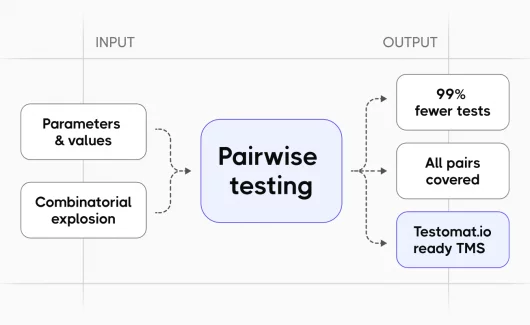
Pairwise testing solves this. It’s a combinatorial technique that lets you cover all pairs of input parameters with a fraction of the test cases exhaustive testing would require, while still catching the majority of defects.
This guide covers how pairwise testing works, when to use it, what pairwise testing tools are available, and how to integrate the technique into a modern testing process.
What is pairwise testing?
Pairwise testing, also called all-pairs testing, is a combinatorial test design technique that ensures every possible pair of input parameter values appears in at least one test case. As a testing technique it sits between doing too little and testing everything, and a well-planned pairwise testing strategy gives you broad coverage from a small set of tests.
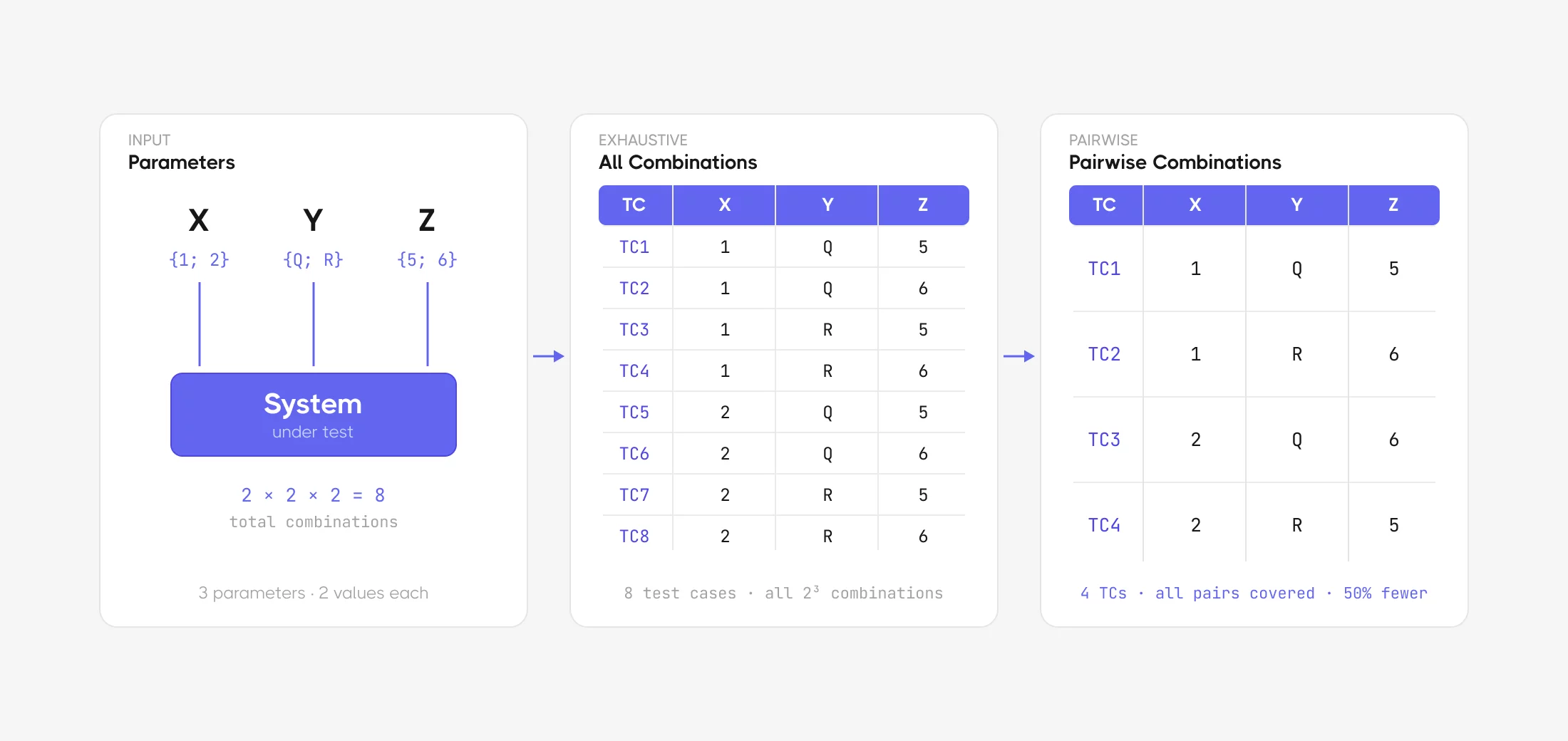
The core insight behind the method comes from research by the National Institute of Standards and Technology (NIST) : studies from 1999 to 2004 found that the vast majority of software defects are caused by interactions between one or two parameters, with progressively fewer defects caused by interactions of three or more. This means testing all pairs of input parameters catches most bugs without requiring you to cover all combinations of every possible configuration.
Pairwise testing is a black-box testing method. You don’t need access to source code. You define the input parameters and their possible values, then generate test cases based on those pairwise combinations. It fits naturally into functional testing and is equally applicable to manual testing and automated pairwise testing workflows.
Why not just test everything?
The problem with exhaustive testing is combinatorial explosion. The number of test cases grows exponentially as you add parameters, because every new parameter multiplies the combinations of input values you would need to cover. Mapping all possible inputs by hand quickly becomes unmanageable, and the count of possible discrete combinations runs into the thousands.
Consider a realistic example from a flight booking interface with multiple input parameters:
- Cabin class: Economy, Business, First (3 values)
- Payment method: Credit card, Debit card, PayPal (3 values)
- Departure airport: 4 options
- Traveler type: Adult, Senior (2 values)
- Seat preference: Window, Aisle, Middle (3 values)
Testing every possible combination requires 3 × 3 × 4 × 2 × 3 = 216 test cases. Pairwise testing reduces the required number to around 20 to 30, covering all pairwise combinations like Business Class + Credit Card and Senior Traveler + Window Seat, while skipping redundant configurations that don’t expose new interactions.
For larger systems, the savings are more dramatic. A configuration with 10 parameters each having 3 possible values requires 59,049 exhaustive test cases. Pairwise testing can cover all two-way interactions with fewer than 50. That’s a reduction of over 99%.
Pairwise testing reduces the number of test cases without meaningfully reducing defect detection coverage, because defects caused by interactions between three or more parameters are rare in practice.
How does pairwise testing work?
The process for creating pairwise test cases follows a consistent pattern:
- Step 1: Identify input parameters. List every parameter your feature or component accepts as input. For a login form, this might be: username format, password length, browser, operating system, and user role.
- Step 2: Define parameter values. For each input parameter, list its possible discrete values. Keep values meaningful. Boundary values and equivalence class representatives are good choices here. Equivalence partitioning and boundary value analysis complement pairwise testing well for selecting which values to include.
- Step 3: Apply constraints. Remove combinations that cannot occur in real use. The Safari + Windows combination, for example, doesn’t reflect real user configurations. Defining these constraints before you generate test cases keeps your test suite realistic and prevents time spent on scenarios that expose no real risk.
- Step 4: Generate pairwise combinations. Use a pairwise testing tool (covered below) to generate the set of test cases that covers all pairs of input parameters. The tool ensures that every possible pair of values between any two parameters appears in at least one test case. It works out the minimal set of parameter pairs and the test cases to cover them, so you never miss a two-way interaction.
- Step 5: Create test cases from the output. Each row of the generator output becomes a test case. Implement these in your test suite , whether as manual testing scenarios or automated test scripts.
Examples of pairwise testing
Example 1: e-commerce checkout
An online shopping platform checkout has these input parameters:
- Payment method: Credit card, PayPal, Bank transfer (3 values)
- Device: Desktop, Mobile, Tablet (3 values)
- User type: Guest, Registered, Premium (3 values) Currency: USD, EUR, GBP (3 values)
Testing all possible combinations: 3 × 3 × 3 × 3 = 81 test cases.
Pairwise testing covers every possible pair (for example, Mobile + PayPal, Guest + GBP, Tablet + Credit card) with around 9 to 12 test cases, roughly an 85% reduction in the number of required test cases.
Example 2: cross-browser testing
Cross-browser testing is a classic fit for pairwise. A web application needs to verify behavior across:
- Browser: Chrome, Firefox, Safari, Edge (4 values)
- Operating system: Windows, macOS, Linux (3 values) Screen resolution: 1080p, 1440p (2 values) JavaScript enabled: Yes, No (2 values)
Exhaustive testing: 4 × 3 × 2 × 2 = 48 test cases. Pairwise testing: around 8 to 12, covering every pair across different browser versions and platforms while excluding impossible configurations (Safari + Windows, for instance).
Pairwise testing tools
Generating pairwise test cases manually is possible for small parameter sets, but becomes error-prone as the number of parameters grows. Pairwise testing tools automate test case generation and handle constraint handling automatically.
PICT (Pairwise Independent Combinatorial Testing)
PICT is a command-line tool from Microsoft that generates pairwise test cases from a model file listing parameters and their values. It supports constraints to exclude invalid combinations and weighting to test certain values more frequently. PICT is widely used in industry and is one of the most established generator tools available.
ACTS (Advanced Combinatorial Testing System)
ACTS is an open-source tool developed by NIST . It’s a Java-based application that supports pairwise testing as well as higher-order combinations (3-way, 4-way, and beyond, known as n-wise testing). ACTS supports constraint handling, mixed strength testing for different parameter groups, and multiple output formats. It’s well-suited for large and complex systems where you need flexibility in combinatorial strategy.
Pairwise online tools
For teams that want to generate pairwise test cases without installing software, pairwise.org and similar online tools provide a web-based interface. You input parameters and values, and the tool outputs a test case table. Pairwise online tools are practical for quick exploration or for teams that aren’t ready to integrate generator tools into their pipeline.
AllPairs and Python libraries
AllPairs is a simple open-source tool for generating pairwise combinations. For Python-based test automation, libraries like allpairspy integrate directly into pytest workflows, generating pairwise combinations from lists of parameter values without requiring external tools. This outputs the minimal set of test cases covering all pairs of input parameters, which you can feed directly into parameterized tests.
Pairwise vs exhaustive vs n-wise testing
Pairwise testing in software development earns its place on most teams. For most software development projects, pairwise testing is the practical starting point. Use 3-way or higher-order n-wise testing when you have specific evidence that three-way interactions in your system are a significant source of defects.
- Exhaustive testing covers every possible combination of input parameter values. It guarantees complete coverage but the number of test cases scales exponentially. For anything beyond a handful of parameters with few values, testing all possible configurations is impractical.
- Pairwise testing (2-way combinatorial testing) covers all pairs. Most defects caused by interactions between parameters are two-way interactions, so pairwise coverage catches most bugs with far fewer test cases. Research from the National Institute of Standards and Technology consistently supports this.
- N-wise testing extends the approach to cover all combinations of n parameters at once. 3-wise testing covers every possible triple of parameter values. 4-wise covers every quadruple, and so on. As n increases, the number of test cases grows and you catch more interactions. But the gains diminish quickly past 3-way coverage, and the reduction in test cases compared to exhaustive testing remains substantial.
When should you use pairwise testing?
Pairwise testing is most useful when:
- Your feature has multiple independent input parameters with several possible values each Exhaustive testing of all possible combinations would take too long.
- You need to reduce the number of test cases without sacrificing meaningful test coverage.
- You’re doing regression testing across different configurations (browsers, OS versions, user roles).
- You’re testing complex systems with configuration parameters that interact.
It’s less useful when parameters are highly dependent on each other (constraint handling helps, but pairwise is less efficient when many combinations are invalid), or when the risk profile genuinely requires testing all possible combinations (certain safety-critical domains).
Pairwise testing best practices
- Define constraints before generating. Invalid combinations waste test execution time and produce meaningless results. Spend time upfront identifying which pairs of input parameters cannot occur together and exclude them from generation.
- Combine with other test design techniques. Pairwise testing works well alongside equivalence partitioning and boundary value analysis. Use those techniques to choose which parameter values to include, and use pairwise testing to decide which combinations to test.
- Don’t rely on pairwise alone for high-risk flows. Pairwise testing in software is a coverage optimization strategy, not a complete testing strategy on its own. Critical paths like payment processing, authentication, and data deletion warrant additional test cases beyond what pairwise generates.
- Use a tool. Manual pairwise test case generation is error-prone and takes a lot of time for anything beyond three or four parameters. PICT, ACTS, or a library like allpairspy handles the combinatorial math and constraint handling correctly, producing test cases that provide full pairwise coverage.
- Track results by parameter value. When you execute pairwise test cases and find defects, note which parameter values were involved. Patterns in which values consistently appear in failing tests often point to root causes faster than inspecting test results in isolation.
Managing pairwise test results in Testomat.io

Pairwise test case generation reduces the number of tests you need to run. But the value of that efficiency disappears if you can’t track what ran, what failed, and which parameter values were involved when something broke.
This is where a test management layer matters. Testomat.io works with the automation frameworks teams already use, including Selenium, Playwright, Cypress, and pytest, and captures results from pairwise test runs alongside the rest of your test suite.
For pairwise testing specifically, what Testomat.io adds is:
- Organized test results by run, so you can compare pairwise regression runs across releases.
- Step-level failure details with stack traces, so you can see exactly which parameter combination caused a defect.
- AI-powered failure analysis that groups similar failures across parameter combinations, which is useful when a single bad parameter value causes failures across multiple test cases.
- Flaky test detection , which is particularly relevant for pairwise tests across browser versions and platforms where environment instability can produce inconsistent results
You can also use Testomat.io’s test case management to create test cases based on pairwise output, track their execution status across regression testing cycles, and report coverage to stakeholders without having to manually assemble that picture from test logs and test data.
The integration is a single reporter package added to your existing test setup. Results flow in during CI/CD runs , and teams working across different browser versions and complex configuration matrices can see the full picture without digging through pipeline logs.
Summary
Pairwise testing reduces the number of test cases your team needs to execute while keeping test coverage high where it matters most. As a testing approach, it helps you identify defects caused by parameter interactions without running every combination. It works because most defects in real software development projects are caused by interactions between one or two input parameters, and pairwise testing ensures every such interaction is covered.
The technique is straightforward to apply: identify your parameters, define their values, add constraints for impossible combinations, generate test cases with PICT, ACTS, or a similar tool, and run them as part of your regular testing process. For teams running automated regression testing across complex systems, pairwise testing is one of the most practical ways to keep your test suite from growing into something nobody can maintain.
Ready to track your pairwise test results properly? Try Testomat.io free for 30 days. No credit card required.