


Artificial intelligence can already write test cases and analyze test results. It can also help with automation. Does this mean QA professionals have less work? The answer is more complex. A team can delegate some tasks to a model. A person then needs to check and revise the output. AI also accelerates development itself, so testing needs to match a faster flow of changes. A comparison helps you understand the future of QA testing. This article starts with the testing process before AI adoption. It then describes the current process and a possible future process.
Testing Before AI: People Work With Every Artifact
A QA professional in a traditional testing process works with a range of artifacts:
- Requirements
- Test cases
- Automated tests
- Test run results
- Bug reports
Some artifacts may be absent. A team may use checklists instead of detailed test cases, or it may lack test automation.
The central figure in this model is the human tester. The tester:
- Analyzes requirements and designs checks.
- Writes test cases and automated tests.
- Explores the application.
- Analyzes results and reports bugs.
The scheme shows this model. The grey lines go from the tester to every artifact. Dashed frames mark artifacts that a team may skip, such as detailed test cases or autotests. Test runs and the TMS sit under the autotests. Analysis and decisions stay on the left, with the person.

A test management system (TMS) helps organize these artifacts. It links cases to requirements and keeps a history of runs. It also provides analytics. This model has worked for years, but it has a clear cost: considerable manual effort and time. Regression testing alone can require substantial work from a team, especially on a large product.
Testing Today: AI Helps and People Supervise
The artifacts in the current model remain largely the same. The change is in who performs the work. QA professionals can delegate some tasks to AI.
A person gives an agent context and a request. The agent generates test cases or helps with automation. The tester then reviews the result and refines the task. The next iteration starts. People also analyze results and make decisions. They configure integrations and prepare skills. Skills are instructions that guide agents through recurring tasks.
The scheme shows the shift. The indigo lines now go from the agents to the artifacts. The person supplies project context and a task. The person then triggers the agent and reviews every iteration. The grey lines for analysis and decisions remain with the person. The person also gains new duties: MCP connections and skills.

This can reduce manual work, but it introduces new costs:
- Project knowledge often exists only in the heads of team members.
- Someone needs to collect the relevant information and give it to the model.
- The tool needs configuration for the product and its processes.
- The first result often needs corrections.
- Review and correction of generated output also take time.
As a result, a team may conclude that some tasks are faster to do manually. Autonomous AI-driven application testing is currently slow and expensive. Its reliability is also often insufficient.
An idealized picture of AI adoption is also a poor comparison point. A well-organized process of this kind is rare. Conversations with QA professionals suggest that a minority of teams work this way. Weak process formalization is a major barrier. People inside a single team may use different tools and approaches. Alignment is often missing.
From Interactive to Autonomous Agents
The central prediction about the future of AI in software QA is a shift from interactive AI workflows to autonomous agents. An interactive agent works together with a person. It receives a task and returns an intermediate result. It then responds to clarification. The person sees and reviews individual steps.
An autonomous agent receives an objective and operating conditions. It then performs most of the work with little step-by-step direction. Reviews and checkpoints remain possible, but the nature of the interaction changes. The person spends less effort on constant dialogue. The effort moves to the task definition and the process configuration. The person also evaluates the final outcome.
The ability to run an agent unattended is only the first condition. The output also needs to be good enough. This requires:
- Context
- Tools
- Working rules
- Verification mechanisms
Requirements Become Critical
Artifacts that some teams previously considered optional become more important in the future of AI in software testing. Requirements are the clearest example.
Poor or missing requirements make it difficult to build the right feature and to test the result. The team lacks a clear expected behavior for comparison with the application. AI can help clarify and document requirements, but people need to make a substantial contribution at this stage.
Spec-driven development fits this context. A team describes a specification or requirements first and then implements the functionality. The approach is useful, and its central idea is old: teams have tried to describe desired behavior before implementation for a long time.
Requirements matter because they support a chain of later artifacts:

A user story may contain acceptance criteria, for example. Each criterion can become several test cases.
Why Test Cases Regain Value
Many QA professionals prefer checklists. Detailed test cases take time to write and maintain, and they can quickly become outdated in a large product. Experienced QA professionals also rarely need step-by-step instructions for obvious actions.
AI changes this calculation. A test case can serve as an instruction for a person and also as an intermediate artifact for the generation of an automated test. QA creates or reviews high-quality cases in this model, and an agent uses them as clearer input for automation.
Each team decides how detailed its cases need to be. The claim is narrower: a test case communicates expected behavior more precisely than a vague requirement or a short prompt when AI generates automated tests. This makes test cases an important part of the future of QA automation.
Many Agents Instead of a Single Assistant
A person in the future model launches an orchestrator agent. The orchestrator coordinates other agents with different roles:
- A general-purpose agent performs several types of tasks.
- A reviewer agent checks the work of other agents.
- A dedicated agent analyzes test runs.
- Another agent creates bug reports.
- Another agent tests the application itself.
The scheme shows this model. The person runs the orchestrator. The agents work with the artifacts and review the output of other agents. The dashed chain from requirements to test cases to autotests repeats the sequence from the previous section. The crossed line from the person to the application marks the main change: manual application testing leaves the human role. Human review and decisions remain.

The number of agents is secondary. The important parts are clear responsibilities and shared context. Agents also need a way to transfer results to each other.
A TMS remains useful in this model. A team can store test cases in Markdown files, but it needs a place to review run history and results. The team also needs statistics and analytics. A TMS keeps its value as a place to visualize and analyze this information. This holds true even if the way to create and store individual cases changes.
The Main Risk: Loss of Control Over Quality
A fully autonomous model is attractive. Processes run with minimal human involvement. Agents perform tasks, and results move from agent to agent. This model has significant problems:
- Technical complexity. Such a system is difficult to build. The ideal architecture and the best tools for it are unknown at this point.
- Loss of control over quality. AI drives the whole process, so a mistake by an agent, or a defect in the verification system itself, can remain undetected. People and models are both unready for a complete transfer of control.
The practical answer is an intermediate model. A team introduces agents gradually and keeps human review and validation wherever necessary.
A Separate Autonomy Level for Each Process
Teams have different products and constraints. Their trust in AI also differs. A single global choice of fully manual or fully autonomous work is unnecessary.
Different tasks can have different levels of oversight. You can:
- Delegate part of test case generation to an agent.
- Allow an agent to automate tests while a person reviews the code and results.
- Keep requirements under direct human control.
- Use AI for an initial analysis of test runs before a professional makes a decision.
Many factors shape output quality:
- Product complexity
- Client constraints
- Documentation
- The chosen model
- The tools and their configuration
- The expectations of the team
AI also sometimes assigns the wrong priority to a test case or handles complex logic incorrectly.
The practical principle is simple. A team delegates only as much as it can oversee.
How Testomat.io Fits These Models
The models above need an agent for test design and management and an agent that tests the application itself. The Testomat.io ecosystem covers both roles.
Testeiya: The QA Agent for the Current Model
Testeiya is a desktop QA agent made for testers. Coding agents work with code. Testeiya works with test artifacts in Testomat.io: requirements, test cases, runs, reports. It matches the QA agent in the scheme below.
- Skills. Ready-made skills for test management and automation. A team can edit them for its processes.
- MCP connections. Testomat.io and Playwright for tests; Jira, Confluence, Linear, Notion for requirements; GitHub and GitLab for code; Figma for design.
- Project context. A connection to a Testomat.io project, a local folder, or a repository. The team adds context about the product and its processes.
- Visible work. The person sees every tool call and plan. Checklists and test cases appear in the chat, with charts for results.
- Model providers. The agent uses a key from the chosen provider. The provider and subscription determine model costs.
The scheme shows the current model with a QA agent in place of several separate agents. The agent carries its skills and tools. It works with the person in an interactive mode and analyzes results in an autonomous mode. Project context and MCP connections stay close to the person. Analytics stay there too.

A short example shows the interactive mode. The agent receives a request to generate test cases for the purchase of a conference ticket. The example has limited context, so the agent first produces a checklist for approval. A person corrects the direction at this step. The agent then writes detailed test cases from the approved checklist. The intermediate step saves time: the system spends effort on the extensive result only after the direction is confirmed.

Testeiya is free with a provider key. A connection to a Testomat.io project needs a paid Testomat.io subscription.
Explorbot: The Agent That Tests the Application
Explorbot takes the role of the test agent from the future model. It explores a web application through a UI map instead of random clicks:
- Research. The agent studies a page and adds it to the map.
- Plan. It chooses a scenario for the page.
- Execute and verify. It runs the scenario and checks the result.
- Keep. It saves what it learned, and the next run explores the pages in new ways.
Explorbot runs from the command line. A CI job can start it and leave it for hours. The output includes Playwright or CodeceptJS specs and screencasts. Run reports appear in Testomat.io, where the team reviews them with the rest of the test results. The agent fits CRUD-heavy web applications best: SaaS products, ecommerce, admin panels. It is free for commercial use, and the team pays only for the AI tokens of the chosen provider.
This is the autonomous end of the scale, so the rule from the previous section applies. A team delegates only as much as it can oversee, and the run reports in Testomat.io provide that oversight.
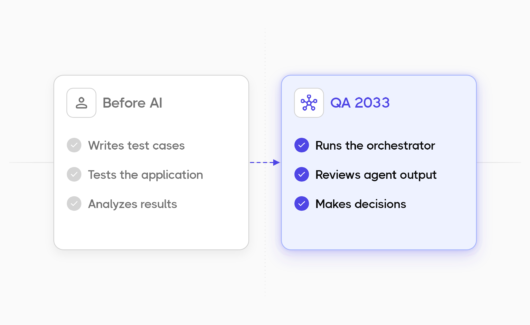
Bottom Line: Who Is QA 2033?
The most radical prediction concerns the future of QA engineer roles. The QA professional of 2033 manages an orchestrator agent and contributes to requirements and some decisions. Direct participation in processes such as test case writing almost disappears. This is a forecast, and some people will disagree. The discussion also raises the question of accountability. An agent can perform an action or admit a mistake in its response, but who is responsible for the consequences?
This is the important dividing line. AI may perform an increasing number of operations, but a team decides what a quality result is and where verification is required. The team also decides who makes the final decision. The future of software testing with AI depends on a gradual introduction of autonomy. Agents are unlikely to replace QA professionals at once. A team starts with clear requirements and formalized context and then moves to agent-based processes with a level of oversight it can trust.
You can take the first step with the artifacts you already have: create a free Testomat.io project and import your test cases, then connect Testeiya or Explorbot with your provider key. Start with a single process such as test case generation and widen the autonomy as the results earn your trust.