






Your suite was green on Friday. A designer renamed one CSS class over the weekend, and now 40 tests are red on Monday. No feature broke. A locator went stale. This is the maintenance tax every automation team pays, and self-healing test automation is the response. See how it works, what it can and can’t fix, and how to fit it into your testing process.
What is self-healing test automation?
Self-healing test automation is an AI-driven capability that detects when a test fails because the UI changed, then repairs the broken locator automatically so the test keeps running without manual intervention.
The idea is narrow on purpose. A self-healing test does not mask real bugs. It handles UI drift: a renamed button, a shifted DOM node, a changed element ID. When the underlying behavior still works but the old locator no longer resolves, self-healing testing finds the right element and updates the test script. When behavior actually breaks, the test still fails, which is what you want. That line between cosmetic change and genuine regression is the whole point of self-healing in test automation.
Why traditional automated tests keep breaking
Traditional automation is built on static object locators: XPath, CSS selectors, element IDs. Each test case verifies specific web elements through those locators. Change the element, and the test fails even though nothing about the product is wrong.
The cost is real and measurable. According to the Capgemini World Quality Report, teams spend 30 to 40% of their total testing effort on maintenance rather than writing new tests. Selector rot is the main driver. Traditional automated tests assume the UI holds still, and modern UIs never do. Every redesign, renamed class, or restructured page risks breaking any test that targets those elements.
So your automation engineers, hired to expand test coverage, end up updating test scripts instead. That is the trade traditional testing forces: a brittle test suite that consumes the time you wanted to spend on new tests. Flaky tests make it worse, since a test that fails intermittently looks the same as one broken by a real change until someone digs in.
How does self-healing test automation work?
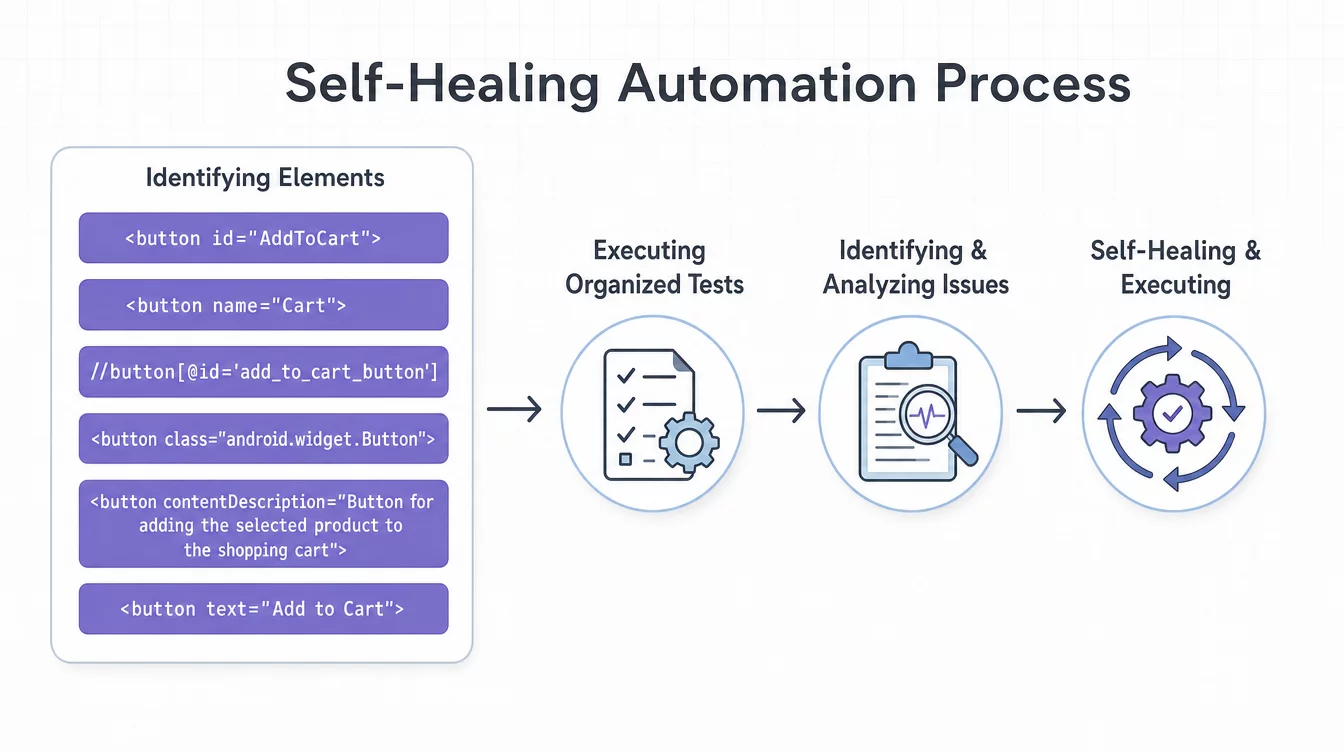
Every self-healing system, traditional self-healing or modern self-healing, follows the same three-step cycle: detection, resolution, and update. The sophistication of each step is what separates a basic self-healing feature from the stronger self-healing tools.
Detection: spotting the broken test step
Detection is where the framework recognizes that a test step failed because a locator no longer resolves to an element on the page. A good self-healing engine captures more than one identifier per element at authoring time, so it has a richer fingerprint to work from when a single locator goes stale. The richer that capture, the more resilient the healing later.
Resolution: finding the right element
Resolution is where AI and machine learning do the work. The system looks for the intended element through alternative strategies: nearby text, ARIA labels, DOM structure, visual similarity, or fuzzy matching on attributes. Some self-healing automation tools score candidates by similarity and pick the closest confident match. This is where AI automation earns its place, because no single fallback locator covers every change.
Update: rewriting the test for future runs
Update is where the system writes the corrected locator back into the test definition, so future tests succeed without repeating the resolution step. This is what automatically updates the test and keeps the suite green. The best self-healing tools log what changed and why, so your team can review the edit before it becomes permanent.
What self-healing can and cannot fix
Here’s the honest part most vendors skip. Selector healing is the easy category, and it is a minority of real failures. Research from QA Wolf found that broken selectors account for only about 28% of test failures. The rest come from timing issues, invalid test data, runtime errors, and visual changes.
That means a tool that only swaps locators leaves most flakiness on the table. Effective self-healing capabilities diagnose the root cause first, then apply a targeted fix. Updating a locator when the real problem is a slow API response just makes a test pass for the wrong reason. Major UI redesigns still need manual updates, and human oversight stays essential. Always review AI-based locator changes before you approve them, because a healed test that quietly drifts from intent is worse than a loud failure.
Benefits of adopting self-healing in your test automation strategy
Used well, self-healing automated tests change the economics of a suite. The headline gain is lower test maintenance. When the framework absorbs cosmetic UI changes, your engineers stop firefighting and start writing new tests, which lifts test coverage over time.
The second gain is signal quality. A suite that minimizes test failures from stale locators gives faster, cleaner feedback, so a red run means a real problem. That improves test reliability and the resilience of automated tests across agile and devops cycles, where the UI changes constantly and continuous testing can’t pause for manual repair. Higher test coverage and faster test cycles follow from the same root: less time lost to brittle scripts.
How to build self-healing into your testing process
You don’t need to rebuild everything to adopt self-healing. Start small and measure.
- Run a proof of concept on your own app. Vendor benchmarks are measured on different applications under different conditions, so they don’t transfer. Take 20 to 30 of your existing tests, break them on purpose with a realistic UI change, and see what percentage heal.
- Review what the healed change looks like. Can your team read and approve the edit? A self-healing process you can’t audit is a liability.
- Keep critical paths strict. Use self-healing for genuinely brittle areas like selector renames. For a checkout flow, you want a loud failure, not a quiet patch.
- Track how often healing fires. Frequent healing in one area is a signal that the UI itself is unstable, which is a test design problem worth fixing at the source.
- Combine healing with good test design. Self-healing test automation tools work best on top of solid architecture, not as a substitute for it. Test automation fundamentally still rewards clean structure.
This is how you use self-healing without handing over judgment. The goal is resilient future tests, not a suite that hides its own decay.
Where Testomat.io fits

Testomat.io is not a self-healing engine, and it won’t rewrite your locators. It is the test management and reporting layer that sits above your runners and whatever self-healing tools you use, so you can see whether all that healing is actually working.
That visibility is the missing piece in most self-healing test automation strategies. Testomat.io syncs automated tests from frameworks like Playwright, Cypress, and Jest, then surfaces flaky test analytics so you can spot which suites heal constantly and which ones are genuinely unstable. Its real-time reporting and stacktraces and exceptions views give your team one place to judge whether a healed test still means what it should.
If you’re building a broader plan, our guides on autonomous testing , AI for QA , and overcoming flaky tests pair well with a self-healing rollout. For where this sits in your wider test automation strategy , the management layer is what keeps healing honest.
Conclusion
Self-healing test automation cuts the maintenance tax that brittle, traditional automation creates, but only when you pair AI-driven healing with strong test design and human review. It fixes UI drift well and genuine behavior changes not at all, which is exactly the line you want it to hold.
Testomat.io gives you the visibility to see whether your healing is working and which tests still deserve trust. Try Testomat.io free and bring your self-healing suite into one clear view.