





When you’re starting a new JavaScript project, or fixing a Jest config that breaks every time you add an ESM-only package, the Vitest vs Jest question keeps coming up in team discussions.
Both run your unit tests well. The real differences are in setup, watch-mode speed, and how cleanly each fits a modern JavaScript stack. In this Vitest vs Jest comparison, you’ll find out how the two runners differ, when to pick each one, and what challenges migration brings if you switch.
Here’s what we’ll cover, starting with the basics.
What are Vitest and Jest?
Both are test runners for JavaScript and TypeScript. A test runner is the tool that finds and runs your test files, then reports pass or fail. The two share almost the same API, so describe, it, and expect look identical in either one.
What is Jest?
Jest is a fully-featured testing framework from Meta, first released in 2014. It comes with everything most teams need out of the box:
- Test runner
- Assertion library
- Mocking
- Snapshots
- Code coverage
For years, it was the default for React projects, and it still powers a huge share of existing JavaScript test suites. Jest is currently on the 30.x line.
Jest runs on Node and was built around CommonJS. That design choice is the root of most of its friction today, and we’ll get to it in the next section. If you want a deeper setup walkthrough, our guide to JavaScript unit testing frameworks covers the fundamentals.
What is Vitest?
Vitest is a test runner built on top of Vite, the modern build tool behind Vue and SvelteKit, among others. It first appeared in 2021 and is now on the 4.x line. Vitest handles TypeScript and JSX natively because it reuses Vite’s pipeline. ES modules work the same way, with no separate transform setup.
Vitest was designed as a near drop-in replacement for Jest. The official docs describe it as compatible with most of the Jest API and ecosystem, so a team switching over rarely has to relearn how to write a test. The difference is everything around the test. Whether you search jest vs vitest or vitest vs jest, the comparison comes down to the same axes.
What’s The Difference Between Vitest And Jest?
Jest is a fully-featured framework built for Node and CommonJS. Vitest is a Vite-native runner with built-in ESM and TypeScript support. The watch mode is faster too. That’s the short version. Here are the vitest vs jest differences side by side.
| Features | Vitest | Jest |
| ESM | Native ESM support, no flags needed | Requires experimental flags |
| TypeScript & JSX | Native through Vite, no extra plugins needed | Needs Babel or ts-jest |
| Watch mode | Tracks the module graph | Re-runs based on git changes |
| Mocking | vi.fn(), vi.mock(), broadly Jest-compatible |
jest.fn(), jest.mock(), original API |
| Snapshots | Supported, but Jest snapshots are not directly portable | Fully supported and highly mature |
| Configuration | Reuses your vite.config |
Separate config plus manual setup |
| Browser mode | Built-in browser mode | None native |
| Ecosystem | Vite, Vue, Nuxt, SvelteKit | Legacy Create React App, older React setups |
ESM and TypeScript support
ES modules (ESM) are the official JavaScript module standard, the import and export syntax. More and more npm packages now work with ESM only. That’s the main problem with Jest. Jest’s ESM support is still experimental and gated behind flags, and mocking an ESM module needs jest.unstable_mockModule instead of the familiar synchronous call.
Vitest treats ESM as the default because Vite does. TypeScript works the same way. There’s no Babel or ts-jest layer to configure, since Vite compiles your TypeScript through esbuild as part of its normal pipeline. For many teams this single difference settles the decision.
Mocking and Snapshots
Older comparisons claim Vitest mocking lags behind Jest. That gap has mostly closed. Vitest’s vi API now handles module mocks and spies. Fake timers and auto-mocking work too, with syntax that maps almost one to one onto Jest’s. Snapshot testing works in both, though existing Jest snapshot files aren’t directly portable and need regenerating after a switch. So the feature difference is smaller than it used to be. The real separation is architecture and speed, which is the next question most teams ask.
Why Is Vitest Faster Than Jest?
The vitest vs jest speed gap comes from how each runner handles file changes. Vitest reuses Vite’s on-demand transform pipeline and tracks a module graph, so it re-runs only the tests a change affects. Jest scans your whole project first to build its module map. That difference is the source of most of the vitest vs jest performance and speed gap people notice in practice.
How Vitest’s watch mode works
When you save a file, Vitest knows exactly which tests import it, the same way Vite’s hot module reload knows which modules to refresh in the browser. It re-runs that small set and nothing else. Jest’s watch mode uses git diff to decide what to re-run, and it slows down on large suites.
Vitest also transforms files only as they get imported during a run, rather than processing everything upfront. That on-demand model is why cold starts and watch cycles both feel quicker. In recent State of JS surveys , Vitest has ranked high on retention among testing tools, and developers consistently cite watch-mode speed as a reason they stay.
Where Jest is a good choice
Speed is just one parameter. Jest’s snapshot serializers are battle-tested for complex component trees, and its --shard flag is well-proven for splitting very large suites across CI runners. Teams running very large suites sometimes find Jest’s sharding more predictable. Jest’s fake timers also handle some edge cases that need a small adjustment after moving to vi.useFakeTimers(). So Vitest leads on speed and modern tooling. Jest still earns its place where suite size and proven sharding matter most.
When Should You Use Vitest or Jest?
Choose Vitest if your stack already uses Vite or ESM-only dependencies. Stay on Jest if it’s deeply embedded in a working Webpack or Create React App setup. Below are the concrete signals, so you can match the runner to your JavaScript project instead of going on vibes.
When to choose Vitest
Reach for Vitest when these describe your project:
- Your app is built with Vite, Vue, Nuxt, or SvelteKit, so the config is already there.
- You depend on ESM-only packages that fight Jest’s module setup.
- You write a lot of TypeScript and want to skip the Babel or ts-jest layer.
- Watch-mode speed matters to your team’s developer experience on a big suite.
When to choose Jest
Stick with Jest when these are true:
- It’s already wired into a working Webpack or older Create React App build.
- You have a deep investment in Jest snapshots and custom serializers.
- Your suite is enormous and you rely on Jest’s proven sharding behavior.
- Nothing is broken, and a migration would cost more than it returns.
The honest answer for many teams: if Jest works for you, stay on it. If you’re starting a new project or already use Vite, you can pick Vitest.
Quick Jest vs Vitest decision framework
In the table below, you can find the row that matches your team:
| If your team has | Vitest | Jest |
| New project and no tests yet | ✅ | ❌ |
| Uses Vite (Vue, Nuxt, SvelteKit, Astro) | ✅ | ❌ |
| Mostly TypeScript, no ts-jest | ✅ | ❌ |
| Monorepo, slow CI | ✅ | ❌ |
| Needs browser-mode tests | ✅ | ❌ |
| Building a component library | ✅ | ❌ |
| Webpack or Create React App build | ❌ | ✅ |
| Small Jest suite, working fine | ❌ | ✅ |
| Large Jest suite, working fine | ❌ | ✅ |
| React Native or Expo app | ❌ | ✅ |
| Angular app on Jest | ❌ | ✅ |
| Custom Jest matchers or serializers | ❌ | ✅ |
Choosing the right testing framework for your team depends mainly on whether your existing test suites work and whether your stack already uses Vite. Jest or Vitest can both run a modern JavaScript project well, and the real call is migration cost against what you’d gain.
How to Migrate From Jest to Vitest
If you decide to switch, the move is mostly mechanical because the two APIs are largely compatible. While renaming files is simple, the risk is the transition period where half your suite runs on each runner and test results land in two separate places.
The migration steps to follow:
- Run the codemod. The official Vitest migration guide walks through the Jest-to-Vitest changes, and community codemods handle the bulk of the renames:
jest.fn()becomesvi.fn(),jest.mock()becomesvi.mock(), and so on. - Swap the config keys. Config maps over with a few predictable swaps:
testEnvironmentbecomestest.environment.setupFilesAfterEnvbecomestest.setupFiles.moduleNameMapperbecomesresolve.aliasin the Vite config.transformusually disappears because Vite handles TypeScript and JSX itself.
- Do a manual pass for what the codemod misses. Mock factory patterns and snapshot paths usually need hand edits. The codemod misses some mock factory patterns and snapshot paths, so budget time for a manual pass. Our tutorial on organizing a Jest testing framework is a useful reference for what your config was doing before you move it.
What Challenges Teams Face After The Migration
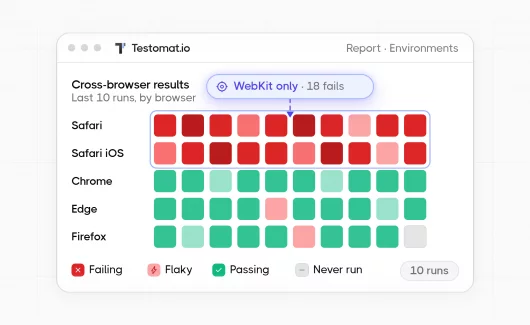
You rarely migrate a large suite overnight. You migrate package by package, which means for a real stretch you have Jest results coming from some folders and Vitest results from others. While the migration finishes quickly, teams face real challenges after it. Let’s overview them below:
Failures you can’t easily classify
The first run on Vitest tends to produce more failures than expected, and not all of them point to real bugs. The common sources are the following:
vi.useFakeTimers()doesn’t match Jest’s timer behavior one-to-one- Snapshots have to be regenerated in Vitest’s format
- Real bugs hide among the migration-only failures
- Flaky tests pass or fail differently than they did on Jest
The flaky case is the worst of them. A test that was unreliable on Jest may pass more often on Vitest, or fail more often, for the same reason. You don’t know which is which from one run.
Lack of visibility during migration
During a mixed migration, visibility suffers most:
- Jest handles some folders and Vitest handles others.
- Each runner writes results in its own format.
- Your QA lead has no single view of the whole status of the test suite.
- Stakeholders don’t get a clear answer about release readiness.
None of these are limitations of either runner. They’re reporting and history gaps, and they’re where most migration time actually goes. A reporter that ingests results from both runners into one view solves this, which is exactly what an AI test management platform like Testomat.io is for.
How Testomat.io Helps Manage Your Test Results
A test runner tells you pass or fail on your machine or in CI. It doesn’t keep your history or flag the flaky ones over time. And it can’t give your QA lead a view across projects. That’s what an AI test management platform handles, and it sits above the runner. Testomat.io is the control center for that quality data, whichever runner produces it.
One reporter for both runners
The Testomat.io reporter is a Node.js package that plugs into popular JavaScript runners. It supports both Jest and Vitest. So during a migration, both runners report into the same place. You have one place to see all your results.
That same reporter feeds flaky test analytics, which flags tests that pass and fail without code changes, and aggregated analytics across projects, so a QA manager can see coverage and trends across every team at once. Your results stay in one place, no matter which runner ran them.
AI failure clusterization after migration
Right after a migration, you get a wave of failures, and some are real bugs while others are migration artifacts like a timer that needs adjusting. Sorting them by hand is slow. AI failure clusterization groups failures by shared root cause, so a wall of red tests collapses into a small set of actual root causes to fix.
AI analysis of failed tests reads each error against past failures and suggests where to look. That turns a noisy post-migration run into a short, ranked to-do list. That’s the difference between sorting failures by hand and making a clear release decision.
Bottom Line
The Vitest vs Jest choice comes down to your stack. On Vite or ESM-heavy projects, Vitest gives faster feedback with less configuration. On a stable Jest and Webpack setup, there’s little reason to move. Neither runner tracks what happens between test runs. Which tests went flaky last week, whether the suite is healthier this sprint than last. That’s what an AI test management platform does. 👉 Try Testomat.io for free and connect your Jest or Vitest results in one place.